What happened
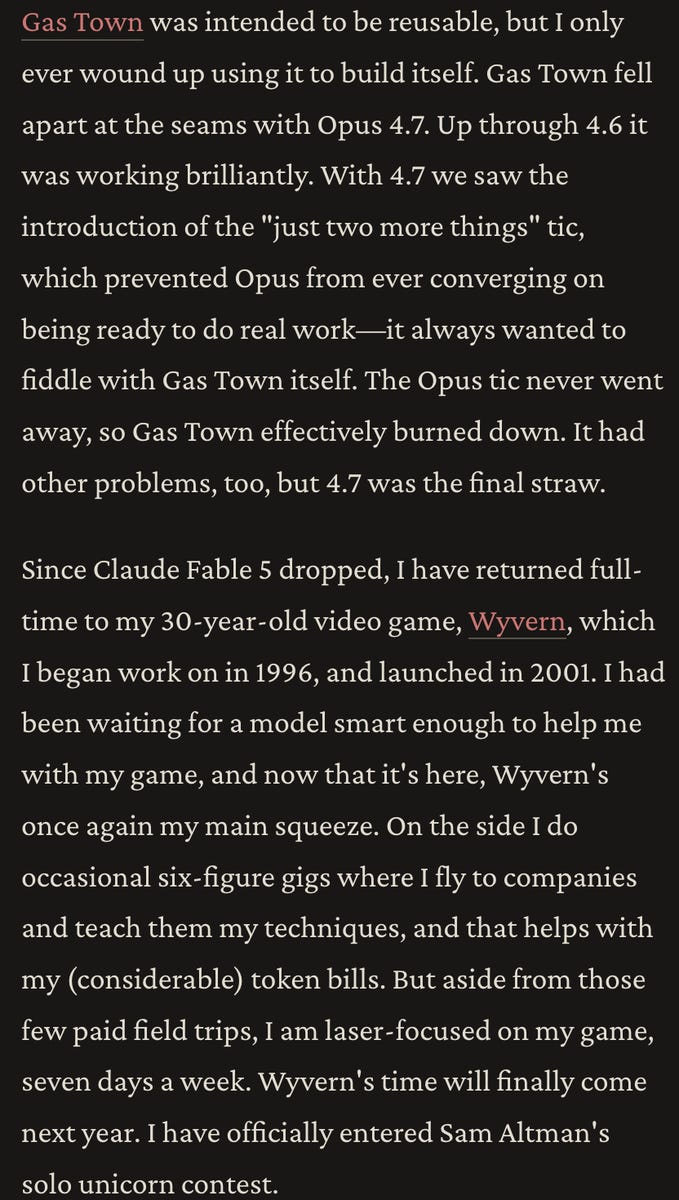
Steve Yegge shut down Gas Town and admitted he never successfully built anything with it, despite spending thousands a month on coding agent subscriptions; Databricks rolled out GPT-6 Astra to ~3,500 engineers, raising total coding spend ~60%.
Why it matters
Even the loudest advocates of heavy AI coding spend are now reporting that the subscription cost did not translate into finished work, and Databricks' headcount-wide rollout added cost even as Astra outperformed prior top-end models on complex tasks.
What to watch
Whether Databricks' dedicated Astra sub-budget actually restores selective use, and whether Yegge's admission shifts how other teams justify per-seat coding agent subscriptions.
WHO IT HITSEngineering leaders budgeting for coding agent seats and AI platform teams deciding between premium long-horizon models and cheaper alternatives now have two public data points on cost and real output.
Summaries like this, in your inbox every morning.
The two reports land together because they test the same assumption from opposite directions. Gas Town was the most prominent public example of the 'orchestrator' pattern — a tool whose purpose was to coordinate coding agents at scale — and its author's admission that he never successfully built anything with it undercuts the case for that layer of tooling. Databricks' rollout tests the other assumption: that a premium long-horizon model will pay for itself when handed to every engineer. Astra did outperform Opus 5 and Sol 5.6 on the hardest work, but the ~60% spend increase arrived alongside an explicit note that medium- and low-complexity coding may not improve much, which is where most day-to-day engineering time sits. That mismatch between where the model wins and where the volume is likely explains the sub-budget response.
The debate over what these two data points mean will likely hinge on how much of the added cost converts into shipped work rather than how the models score on benchmarks. Teams that adopt premium models per-seat will probably face the same conversation Databricks preempted with a sub-budget, while teams that invested in orchestrator layers may re-examine whether the reliability of task completion justifies the coordination overhead. For vendors, the relevant question is whether selective, high-complexity use — rather than broad seat distribution — becomes the default enterprise go-to-market motion.
For example, today's edition would include:
AI-summarized, only the topics you pick — one digest a day via Email, Slack, or Discord.
Free · 30 seconds with Google · unsubscribe anytimeWhat is AIToday? →
Ask AI anything about this article. Q&As are published on this page for other readers too.
At the China International Optoelectronic Expo (CIOE), German laser and plasma generator maker Trumpf presente…

According to the S&P 500's Shiller Price-to-Earnings (P/E) Ratio, this is the second-priciest stock market in…

Bloomberg reported that Crux AI, Blackstone and Alphabet's cloud venture, is set to receive $22 billion in chi…

GM CEO Mary Barra said skilled trades may be more AI-proof than some white-collar paths, with technicians earn…

Fed Chair Kevin Warsh told reporters that hyperscalers 'out in the market raising funding' are part of why the…

Liam Dunne and Ben Moore of Discover Labs said AI search has shifted buyer behavior because people now consume…