What happened
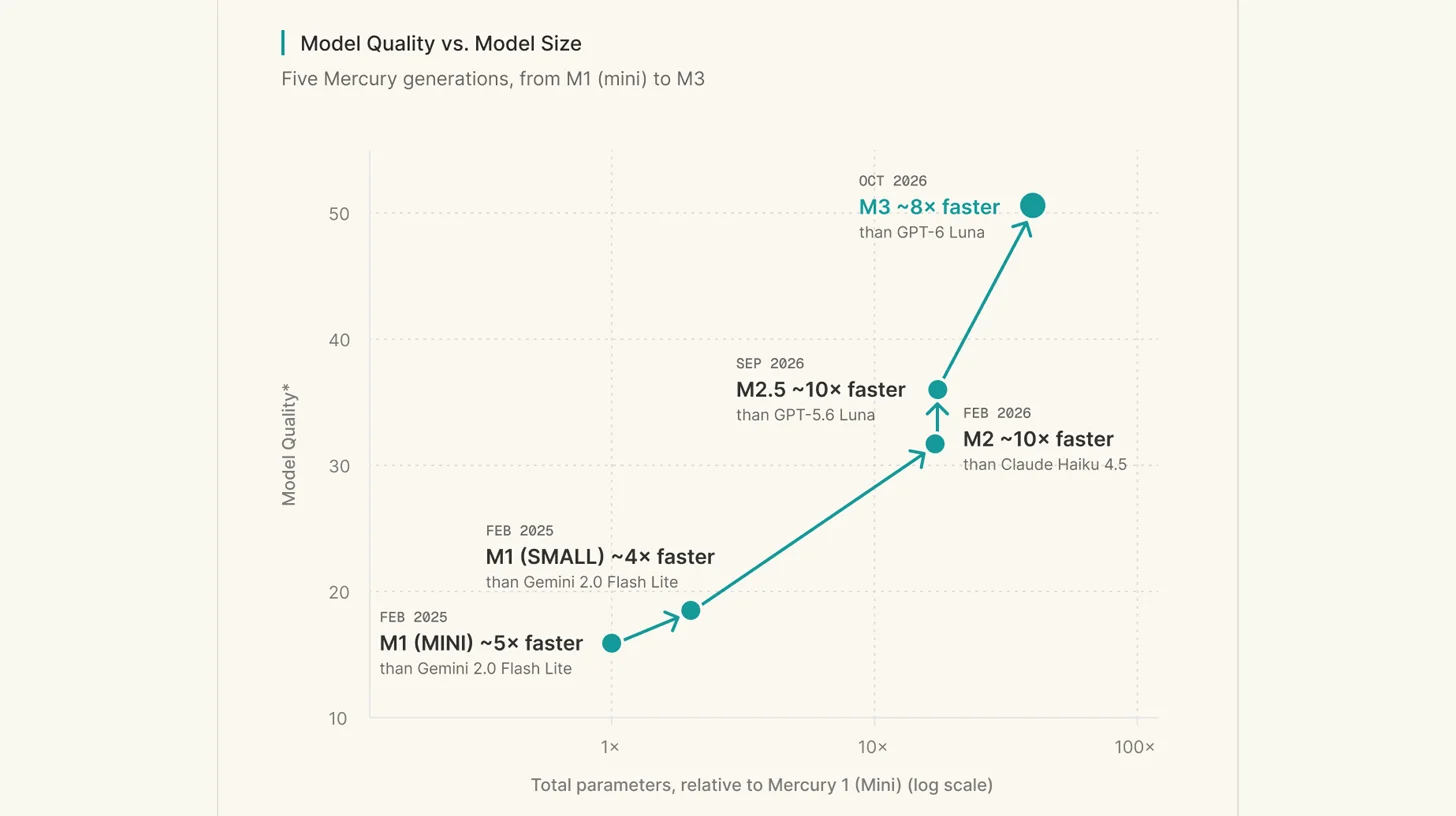
Inception launched Mercury 3 on October 19, a diffusion model it says generates 1,068 output tokens per second on NVIDIA GPUs — four to eight times faster than GPT-6 Luna and Claude Haiku 5.5. It is priced at $0.20 per million input tokens and $0.70 per million output tokens.
Why it matters
The speed opens up interactive work like live tutors and voice support, where a capable answer has to arrive fast enough to keep an exchange moving. Inception concedes mixed benchmark results at medium effort, so replacing frontier models on hard reasoning would need more evidence.
What to watch
OpenAI's January 14 agreement with Cerebras calls for 750 MW of compute capacity aimed at fast responses, with capacity scheduled to come online in phases through 2028.
WHO IT HITSTeams building live tutors, voice customer support and browser agents are the clearest near-term users, since shorter pauses could keep conversations flowing. Developers weighing Mercury against frontier models will need to measure time to first useful response, task success rate and retry costs under realistic traffic.
Summaries like this, in your inbox every morning.
Inception's pitch rests on a design choice rather than raw scale. Mercury 3 is a diffusion model, which drafts many tokens at once and refines them, in contrast to autoregressive models that build answers one token at a time. The company says the model has more than 40 times Mercury 1's total parameters while maintaining similar speeds — an attempt to show the approach can grow without giving up its core advantage.
The launch lands in a market where speed is already a selling point. OpenAI announced GPT-6 Astra Ultrafast on September 29, advertising up to eight times faster token generation in Codex and up to six times faster generation in the API, and its January 14 agreement with Cerebras calls for 750 MW of compute capacity designed for fast responses. Inception is betting a different model design can give it an edge against that hardware-and-pricing push.
The practical question for buyers is narrower than the headline speed figure. OpenAI's own Ultrafast documentation warns that time spent opening connections can eat into gains from faster generation, and recommends keeping a WebSocket connection open for agents that call tools repeatedly. Faster text generation can still leave users waiting on the rest of a workflow, which is why Inception points to live tutors, voice support and browser agents rather than hard reasoning as Mercury 3's clearest opening.
Pick your industry and the AI tools you use, and get news related to your work every day.
Free · 30 seconds with Google · unsubscribe anytimeWhat is AIToday? →
Ask AI anything about this article. The AI reads this article, earlier AIToday articles, and Wikipedia, and cites its sources. Q&As are published on this page for other readers too.
Schneider Electric, Nvidia and HPE formed a strategic collaboration to launch Industrial AI Agents at the Edge…

Anthropic released Claude Duet, built on Claude Opus 5.5

Anthropic reported that an internal version of Claude generated 318,484 candidates over a 64-hour run and sele…
NTT Data and NTT Data Tokai will start a joint proof-of-concept with Aichi Bank on October 26, testing a conve…

WD measured that an 8-second AI video (a 3.97MB 720p file for the user) generated more than 500MB of back-end…
OpenAI's GPT-5.6 Sol found two critical PHP vulnerabilities, CVE-2026-109618 and CVE-2026-109619, collectively…