What happened
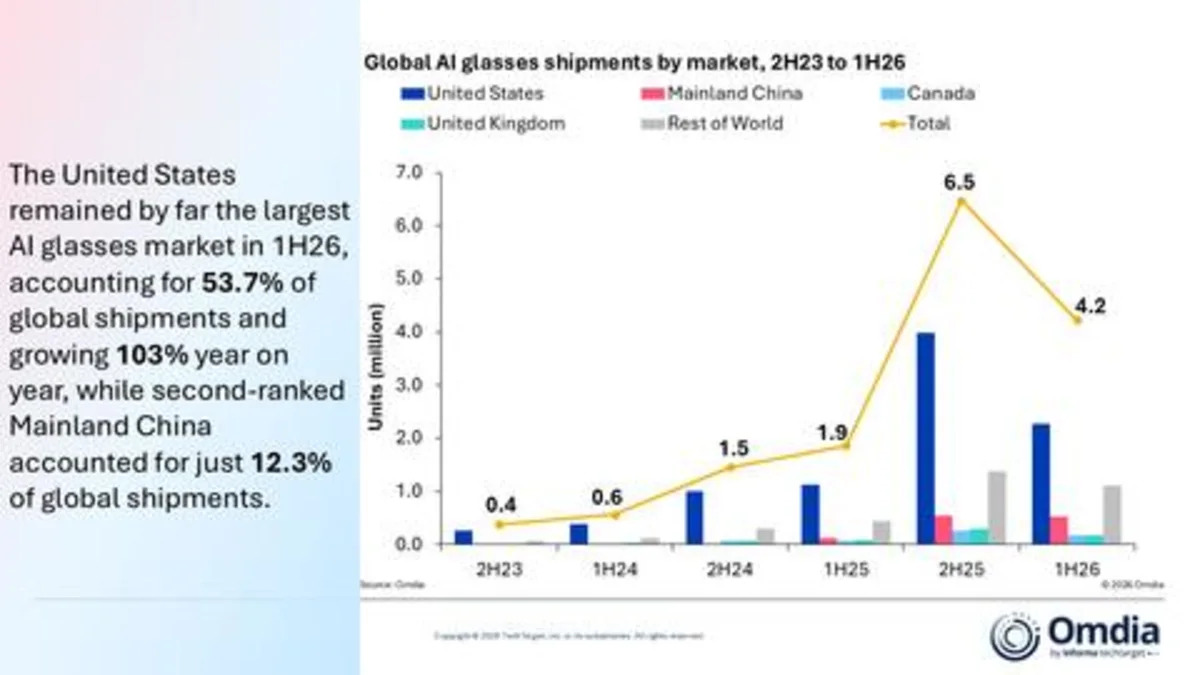
Omdia says global AI glasses shipments reached 4.2 million units in 1H26, up 127% year-on-year, with Meta shipping 3.4 million units for an 81.3% share.
Why it matters
One vendor took over four-fifths of a market that still sits on a very low base, so the headline growth rate rests on a small installed footprint.
What to watch
Omdia flags tightening privacy scrutiny of camera-equipped glasses, which will test whether buyers keep adopting always-on cameras. Watch China, where shipments rose 306% year-on-year in 1H26.
WHO IT HITSThis lands on hardware brands and their retail partners deciding which AI glasses to stock, and on privacy and compliance teams at any company shipping camera-equipped frames into the US and Europe.
Summaries like this, in your inbox every morning.
Omdia's 1H26 figures show an AI glasses category that is growing fast but from a very low base, which is why the 127% year-on-year jump lands on just 4.2 million units worldwide. The concentration behind that number is the striking part: Meta shipped 3.4 million of those units, an 81.3% share, so the global story is largely one company's momentum. Qiran Ju, a senior analyst at Omdia, credits Meta's continued momentum plus a wave of new Chinese entrants, and notes that vendors have made the pitch simple for buyers — hands-free photo and video capture, open-ear audio, and AI assistance inside ordinary-looking frames.
The divergence between markets is the other thread. The US remains by far the largest market, while mainland China is acting as both a supply chain hub and a testbed for different hardware setups; its shipments rose 306% year-on-year in 1H26. Yet China stays fragmented, with Alibaba, INMO, and Xiaomi together accounting for just 46.1% of shipments. Even Realities illustrates the alternative-design route, moving from fifth place in 2H25 to second in 1H26 on 102,000 units and a 2.4% share, by stripping out camera and speakers and leaning on a slim frame, a monochrome display, and real-time transcription. Jason Low, Omdia's research director, reads that as early evidence that no single design fits all uses, a trend he expects to define the global market as form factors and features multiply.
The open question is whether privacy scrutiny becomes the brake. Low argues that settings and messaging will not be enough, and that companies need to define what always-on cameras capture, show users how the content is used, and guarantee it never reaches third parties. Whether that pressure reshapes product design — or simply adds a compliance cost as volumes climb — is likely the test for the second half.
For example, today's edition would include:
AI-summarized, only the topics you pick — one digest a day via Email, LINE, or Slack.
Free · 30 seconds with Google · unsubscribe anytimeWhat is AIToday? →
Ask AI anything about this article. Q&As are published on this page for other readers too.
In a 46-minute interview on CBS, Nvidia CEO Jensen Huang pushed back against apocalyptic warnings about AI and…
China's 15th Five Year Plan (2026-2030) makes embodied AI a top priority, with subsidies and humanoid training…

Apollo's Torsten Sløk told clients the AI spending race depends on hyperscaler operating cash flow more than t…
LG Energy's battery energy storage system (BESS) has qualified into Nvidia's AI Factory ecosystem
China's internet regulator is reportedly investigating DeepSeek and Moonshot AI over allegations they routed m…

AeroVironment's quarter brought confirming data — EHEL awarded, a LOCUST international sale announced, and Tit…