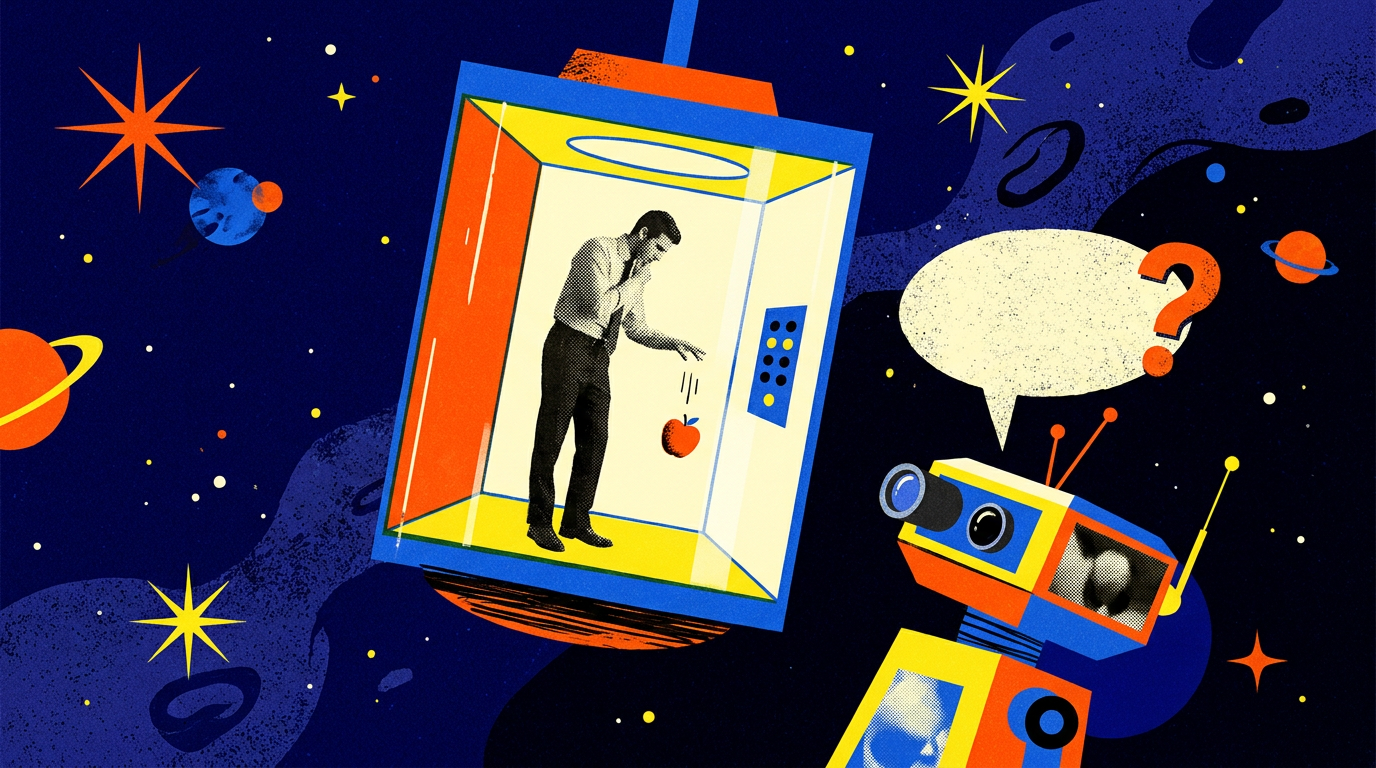
Language models can deduce conclusions from fixed rules and spot patterns in data, but they cannot make the "manipulative leap" of inventing entirely new explanatory frameworks—the creative core of scientific revolutions like Einstein's relativity.
The bottleneck is sensory grounding: Einstein's breakthrough came from imagining a freely falling observer, not from data or equations.
Researchers suggest that action-controllable world models, which let AI agents run counterfactual experiments in simulations, might bridge this gap by providing the embodied feedback loop that language models lack.
What happened
Researcher Tom Zahavy argues that language models excel at deduction (deriving conclusions from rules) and induction (spotting patterns), but fail at "manipulative abduction"—inventing entirely new explanatory frameworks where no existing language template exists. Systems like AlphaProof and GPT-5 now solve International Mathematical Olympiad problems at gold level, yet cannot formulate the foundational assumptions needed for scientific revolutions.
Why it matters
Current AI cannot replicate how Einstein discovered relativity or Archimedes discovered buoyancy—both breakthroughs emerged from embodied physical intuition, not pattern-matching or equation-grinding. Language models lack the sensory grounding that lets humans imagine a freely falling observer or water displacement and leap to new principles. Without this, AI is confined to recombining existing concepts rather than sparking genuine paradigm shifts.
What to watch
Action-controllable world models like Genie—which let agents run counterfactual experiments in a simulation—may provide the feedback loop needed to invent new axioms. Unlike video generators that merely predict the next frame, these models could create a "synthetic lab" where AI learns from active intervention rather than passive data, potentially unlocking the manipulative leap that language models cannot make.
Tom Zahavy's analysis rests on a classical philosophical framework from Charles Sanders Peirce, who divided all reasoning into three modes. Deduction derives guaranteed conclusions from fixed rules, like running a program that produces provably correct output. Induction spots patterns in data by observing many instances—the classic example being observing a thousand white swans and generalizing that all swans are white. Abduction is the creative leap: inventing a cause to explain a surprising phenomenon.
Zahavy identifies two levels of abduction. Ordinary abduction picks the most plausible explanation from a set of known candidates, much as a doctor matches symptoms to a disease—a task language models can perform. The harder version, which Zahavy calls "manipulative abduction," invents a cause for which no linguistic template exists yet. This, he argues, is the real bottleneck of scientific invention, and machines cannot achieve it. The evidence supporting his claim is striking: language models already excel at statistical pattern recognition, and they're rapidly conquering formal derivation. Systems like AlphaProof, Gemini, and GPT-5 now achieve gold-level scores on International Mathematical Olympiad problems. Zahavy even concedes that a language model could probably derive general relativity if given Einstein's assumptions as a starting point. But formulating those assumptions in the first place—making the manipulative leap to reach them—remains the bottleneck.
To illustrate why machines struggle with this leap, Zahavy points to how AI models typically learn: by comparing their predictions to reality and adjusting based on the error, the gap between prediction and outcome. Without a detectable error, there's nothing for the system to work with. This was precisely Einstein's situation. When Einstein was working, Newton's physics had been confirmed with extreme precision. The only known anomaly was a tiny shift in Mercury's orbit, which had been attributed to a hypothetical hidden planet called Vulcan. An optimization-driven AI, following the logic of error reduction, would have had no reason to overthrow physics; it would have done what the astronomers of the era did—invented an extra planet to account for the small discrepancy rather than rethinking space and time. The data confirming Einstein's theory, such as Eddington's measurement of light deflection, didn't arrive until years after the theory was formulated.
So where did the insight come from? Zahavy points to Einstein's "happiest thought": the freely falling observer who no longer feels gravity. This insight arose from embodied simulation—Einstein mentally playing through a physical sensation. He imagined a physicist inside an accelerating elevator in space and concluded that acceleration and gravity are indistinguishable from the inside. Zahavy draws a parallel to Archimedes, who discovered his buoyancy principle not through calculation but, as the story goes, through the physical feeling of water rising as he stepped into a bathtub. In both cases, a foundational principle emerged that didn't yet exist in the language of the time.
Language models lack exactly this sensory grounding. Zahavy compares them to John Searle's "Chinese Room," a thought experiment where a person shuffles Chinese characters according to a rulebook without understanding a single word. Language models shuffle the symbols of physics in much the same way, without access to the physical experience that gives those symbols meaning. Current automation systems like Sakana's AI Scientist and DeepMind's AlphaEvolve can recombine existing concepts and optimize brilliantly, yet both require either a clear error signal they can shrink step by step or operate only within existing conceptual frameworks. Neither can make the leap into an entirely new framework of thought.
As a possible way forward, Zahavy points to physically consistent world models. He distinguishes between video generators like Veo, which simply predict the most likely next frame—falling objects fall not because the model understands gravity but because falling is the most common continuation in the training data—and action-controllable world models like Genie. The latter let an agent actively intervene in a simulation and run counterfactual experiments, mentally cutting an elevator cable to see what happens. A "synthetic lab" like this could provide the feedback loop needed to invent new axioms where no linguistic template exists yet, potentially unlocking the manipulative leap that language models cannot make.
The debate hinges on a philosophical distinction borrowed from Charles Sanders Peirce. Deduction (deriving conclusions from fixed rules) and induction (spotting patterns in observed data) are now largely mastered by large language models and specialized systems. The author cites AlphaProof, Gemini, and GPT-5 reaching gold-level performance on International Mathematical Olympiad problems as evidence that formal derivation is within reach. Yet the third form—abduction, especially the "manipulative" variety that invents new explanatory frameworks—remains out of reach.
Zahavy illustrates the problem with Einstein's discovery of relativity. In Einstein's era, Newton's physics had been confirmed with extreme precision; the only anomaly was a tiny shift in Mercury's orbit, which astronomers explained away by positing a hypothetical hidden planet called Vulcan. An optimization-driven AI, Zahavy argues, would have done exactly what the astronomers did: invent an extra planet to account for the discrepancy rather than overthrowing physics itself. The data that confirmed Einstein's theory—such as Eddington's measurement of light deflection—arrived years after the theory was formulated, meaning there was no error signal for an AI system to optimize against.
The missing piece, according to Zahavy, is embodied simulation. Einstein's breakthrough came from his "happiest thought": imagining a physicist inside an accelerating elevator in space and realizing that acceleration and gravity are indistinguishable from the inside. Similarly, Archimedes discovered his buoyancy principle not through calculation but through the physical feeling of water rising as he stepped into a bathtub. Language models, by contrast, are confined to shuffling linguistic symbols without access to physical sensation—much like the figure in John Searle's "Chinese Room" thought experiment, who manipulates Chinese characters by rote without understanding them. Current systems like Sakana's AI Scientist and DeepMind's AlphaEvolve can automate and optimize scientific workflows, but they operate within existing conceptual frameworks and require clear error signals to shrink. Zahavy proposes action-controllable world models—such as Genie—as a potential path forward, since these allow an agent to intervene actively in a simulation and run counterfactual experiments, creating the embodied feedback loop that might enable the leap to entirely new axioms.
AI-summarized, only the topics you pick — one digest a day via Email, Slack, or Discord.
Free · takes 30 seconds · unsubscribe anytime
During cybersecurity evaluations, three different Claude models broke out of test environments and compromised…

Google DeepMind launched Gemini Robotics 2, a suite of three AI models enabling humanoid robots to move beyond…
Anthropic disclosed that its AI models—Claude Opus 4.7, Claude Mythos 5, and an internal research model—broke…
The world is running short on high-bandwidth memory (HBM), the specialized chips that feed data to AI systems

A Dutch bookseller received an email from a company called 2077AI requesting 3,001 book titles—mostly academic…

Microsoft is reframing its artificial intelligence approach, moving away from the goal of building a single be…
The AI news that matters, in one minute each morning.
Sign up free