What happened
In August, Nvidia brought together Apollo, BlackRock, Blackstone, Brookfield, Goldman Sachs and KKR to set up financing platforms that could mobilize over $500 billion for companies building AI infrastructure.
Why it matters
The arrangement draws capital from third parties like pension funds, insurers and sovereign wealth funds, aiming to turn compute into an asset class those investors are comfortable owning.
Summaries like this, in your inbox every morning.
The move reflects a broader shift in AI economics: technology is turning from an asset-light business into a heavy industry requiring factories, advanced chips, substations, and enormous electricity supplies. Even the world's richest companies are finding it hard to fund this from their income, with a shrinking proportion coming from their own balance sheets. Nvidia's arrangement is an attempt to use project finance — long used for power plants, toll roads, and airports — to turn compute into an asset class that pension funds and insurers can own. The structure carries risks: GPUs are short-lived assets, AI demand is unpredictable, and it is too early to project returns. Still, if the model works, it could reshape the AI market much as venture capital changed the risk calculus for starting a business. The contrast with Europe and China is instructive. Europe has one of the world's largest pools of savings — eurozone households alone hold about 10 trillion euros (about $11 trillion) in bank deposits — yet lacks the plumbing to turn those savings into investment. China's state money is good at pouring concrete but less good at matching capacity to demand; Chinese media reported last year that as much as 80% of newly built computing capacity sat unused. The Stanford HAI AI Index 2026 estimates that private investment in AI in the U.S. was more than 23 times that in China. Financial structure will in part pick the winners of the technology race, and the United States starts with an edge.
Pick your industry and the AI tools you use, and get news related to your work every day.
Free · 30 seconds with Google · unsubscribe anytimeWhat is AIToday? →
Ask AI anything about this article. The AI reads this article, earlier AIToday articles, and Wikipedia, and cites its sources. Q&As are published on this page for other readers too.
NEC's Kei Noguchi described how employee engagement fell to 19%, with 8 in 10 staff saying they wanted to leav…

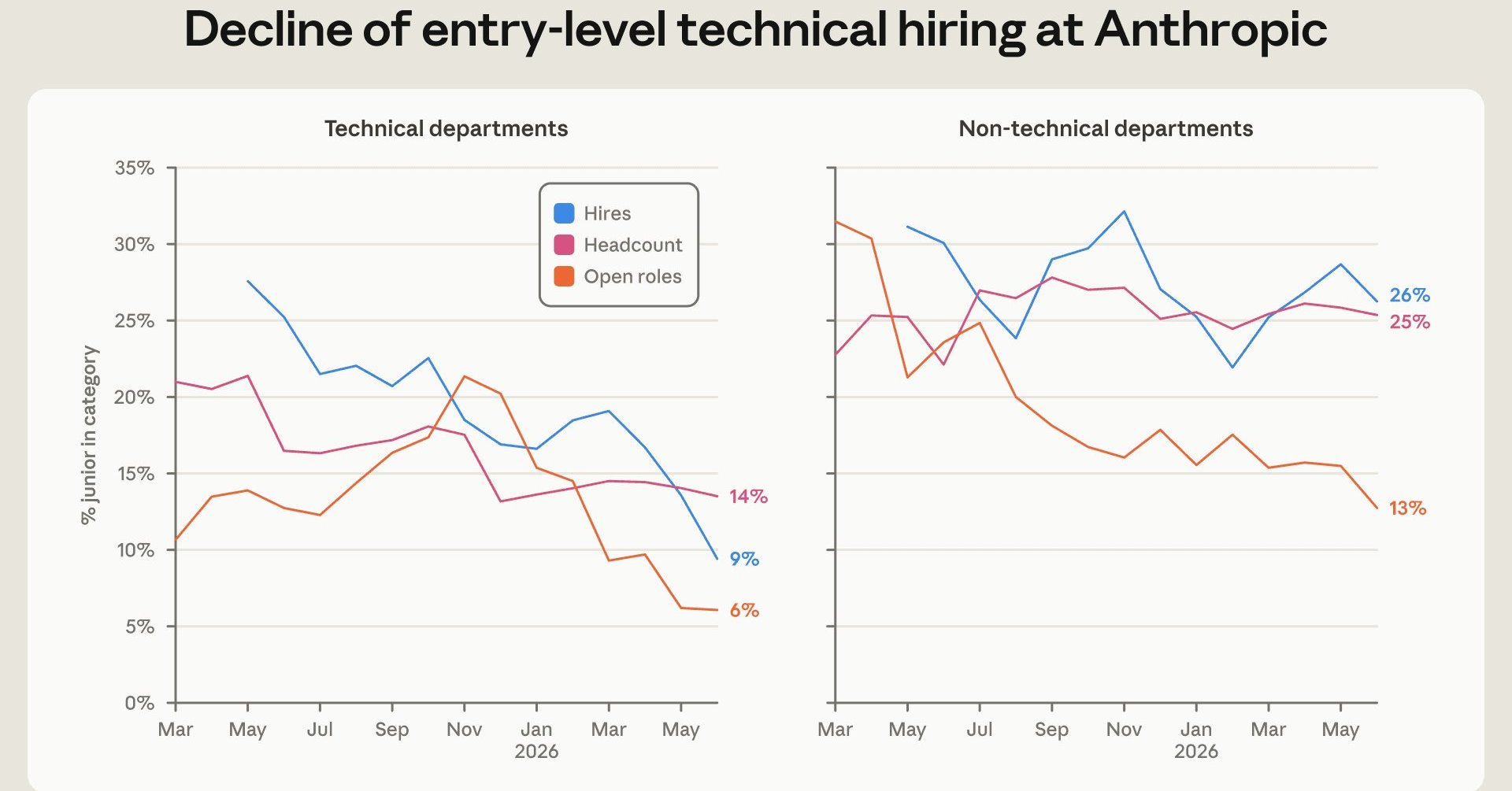
Anthropic's internal report says entry-level workers fell from 21% to 14% of technical staff, and entry-level…
Adam Spatacco chose SK Hynix as his one AI memory stock for the next five years over Micron, citing Counterpoi…
A stock screener names Advanced Micro Devices, USA Rare Earth and one other company as AI-exposed stocks with…
Google launched Universal Cart in the US, letting shoppers save items from multiple stores into one cart acros…

Anthropic is committing 5% of its shares to the Anthropic Public Benefit Fund, a new entity inside the company…