What happened
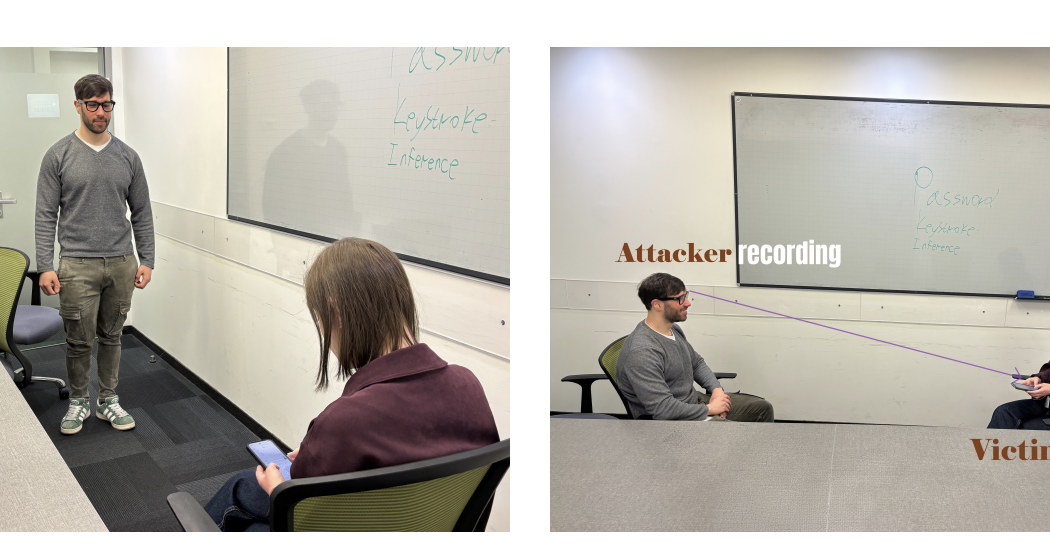
A Tel Aviv University paper, "Watch and Crack: Password Inference from Smart-Glasses Video," showed that footage from Meta Ray-Ban–style glasses let an attacker infer passwords from finger movements, succeeding on keystroke identification 77.8% of the time across 16 participants, at distances up to 1.8m.
Why it matters
Screen-privacy films and privacy displays hide the screen, but recording the fingers still exposes passwords, so shoulder-hacking habits are no longer enough protection.
Summaries like this, every morning.
The paper's starting point is that smart glasses such as Meta Ray-Ban look like ordinary eyewear, so people are unlikely to notice they are being filmed — and because the attack reads fingers from the front, it bypasses the habit of guarding against someone looking over your shoulder. Earlier video-analysis work had been limited to simple conditions such as tablets with large keys or 4-digit PINs. This study claims a broader scope: natural typing on a phone, with no prior knowledge of the device or keyboard app.
The pipeline tracks fingertips at sub-pixel accuracy using an image-recognition model (SAM 3) and a hand-tracking model (MediaPipe Hands), then uses a 3D neural network to pinpoint the moment a key is pressed, discarding backspace corrections. It works out the on-screen keyboard area from the shift and layout-switch keys that must be pressed to type uppercase letters and digits, then combines per-key press probabilities from the video with statistics from about 2.2 billion leaked passwords to narrow the candidates.
The limits the researchers report point to where the risk is lower: accuracy drops for young people who type fast with very small finger movements, for people who type hesitantly, and for those who press with both thumbs almost simultaneously.
Pick your industry and the AI tools you use, and get news related to your work every day.
Free · 30 seconds with Google · unsubscribe anytimeWhat is AIToday? →
Ask AI anything about this article. The AI reads this article, earlier AIToday articles, and Wikipedia, and cites its sources. Q&As are published on this page for other readers too.
monday.com's Ryan Nigro told theCUBE at the company's Elevate event that AI agents inherit employees' access…
Fujitsu began offering a retainer service from 10月30日 that pairs a threat analysis AI built on フロンティアAI with i…
OpenAI updated its Model Spec, which sets out five principles for its AI models: be loyal to human intent, min…
David Durman, a University of Kentucky administrator and nontheistic Humanist, secured a religious exemption f…
SORACOM's Shibata tested whether Meta's Muse agent, in its Linux VM, could reach IoT devices via SORACOM Arc a…

Lockheed Martin's AI Center (LAIC) applies RAGE — Responsible AI Governance and Evaluation — at multiple tollg…