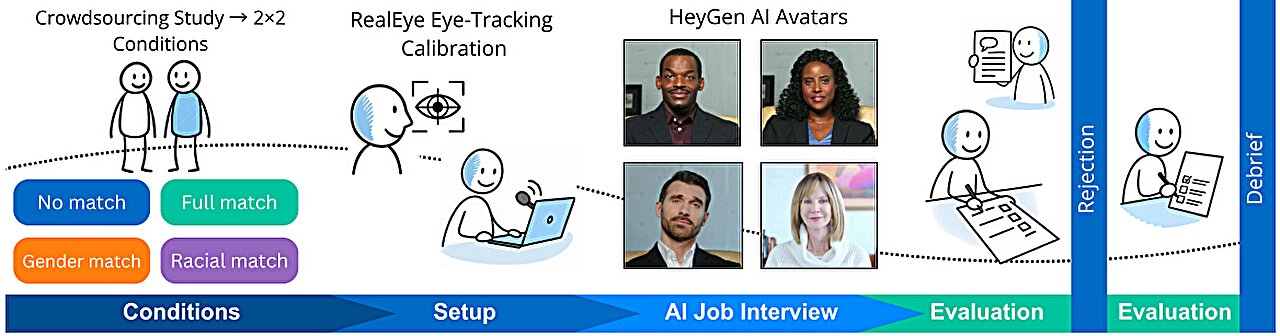
A study of 220 job interview participants found that applicants perceived AI hiring decisions as most unfair when the avatar interviewer shared only one demographic trait (gender or skin color) with them—rating the outcome less fair than when they shared both traits or neither.
Even though applicants maintained high trust in AI during the interview, rejection triggered perceptions of bias based on avatar appearance, suggesting that social cues from avatars shape fairness judgments independently of the AI's actual decision logic.
What happened
Researchers from Technical University of Munich and Lund University studied how approximately 220 job interview participants from Germany, the United Kingdom, and the United States perceived fairness in AI hiring decisions. They interacted with photorealistic avatars (programmed as either male or female, with dark or light skin) that conducted simulated interviews for a customer support position. After all participants received rejection, eye-tracking and questionnaire data revealed that those who matched the avatar in only one characteristic—either gender or skin color—judged the decision most unfairly, rating it more negatively than participants who matched in both characteristics or differed completely.
Why it matters
Companies increasingly use AI avatars to conduct job interviews and make hiring decisions, partly because AI is widely believed to be less biased than humans. However, this study shows that even when the underlying AI model itself is unbiased, applicants' perception of fairness depends on the avatar's appearance and how it aligns with their own. This suggests that social reactions to avatars can override trust in the technology itself, creating a fairness problem that purely technical bias-reduction cannot solve.
What to watch
The research team emphasizes that insights into social behavior must be given greater consideration in AI design if recruitment processes are to be perceived as fair by all involved. The findings are published in the Proceedings of the 2026 CHI Conference on Human Factors in Computing Systems.
Ask the AI about this article →
The use of AI avatars in hiring is motivated by a straightforward logic: automation saves time, and algorithms can be trained without human bias. Yet this study reveals a layer of fairness risk that technical debiasing alone cannot address. During the interview phase, applicants showed no difference in trust based on avatar demographics—but once they received a rejection, the avatar's appearance became a lens through which they interpreted the decision. The counterintuitive finding is that partial demographic alignment was worse than complete mismatch; when an avatar shared one trait with a participant, the participant was more likely to attribute the rejection to bias than when the avatar was completely different or completely similar.
This suggests that partial similarity may activate social categories in the applicant's mind in a way that either complete similarity ("we are the same") or complete difference ("this is a machine") does not. The research team argues that companies cannot address this purely by making their training data unbiased; they must rethink how the avatar itself is designed and how applicants are prepared to interact with it. For businesses deploying AI hiring tools, the implication is that visual design choices carry real consequences for how fair the process feels, even when the underlying algorithm is neutral.
For example, today's edition would include:
AI-summarized, only the topics you pick — one digest a day via Email, Slack, or Discord.
Free · takes 30 seconds · unsubscribe anytimeWhat is AIToday? →
Ask AI anything about this article. Q&As are published on this page for other readers too.
BHP, the world's largest mining company by market capitalization, has deployed AI across its operations

Team Liquid announced a new five-year extension of its long-running collaboration with Dell Technologies' Alie…

A University of Mississippi study published in Journal of Interactive Advertising found that AI ads succeed wh…

Goldman Sachs Research says AI supply and demand won't balance until the first half of 2028

Lam Research broke ground yesterday on a new lab in Tualatin, Oregon

Visa, Mastercard, and Fiserv joined the Agentic Payments Alliance (APA), a 26-company coalition led by stablec…