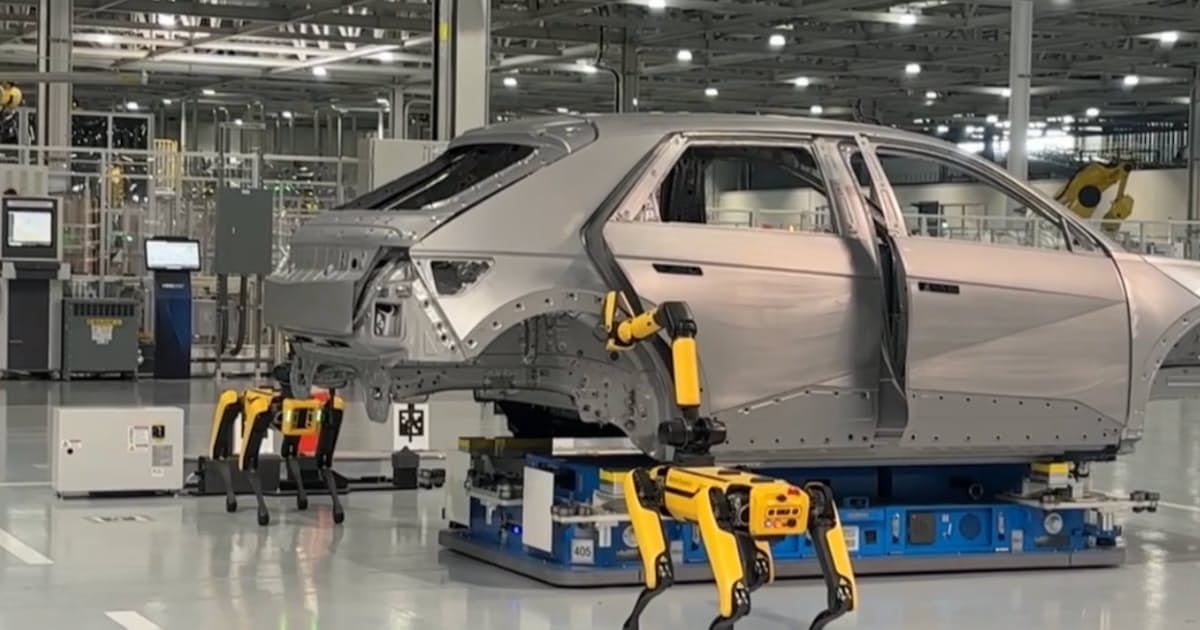
Hyundai's US EV plant uses 1,400 robots.
The robot-to-human ratio is 2:1, over three times the average.
This highlights growing automation in car production.
What happened
Hyundai's new US EV factory operates 1,400 robots, giving it a robot-to-human ratio of 2:1—more than triple the industry average, the article reports.
Why it matters
The figure highlights how far leading manufacturers are pushing automation in EV production, signaling that high robot density is becoming a competitive factor in the sector, the article suggests.
What to watch
The plant's reliance on robots may hint at future labor strategies and automation trends in the broader auto industry, though the article notes no explicit plans or projections.
Ask the AI about this article →
The report on Hyundai's US EV plant, with its 1,400 robots and a 2:1 robot-to-human ratio, points to a notable shift in manufacturing operations. The ratio is more than triple the industry average, suggesting that automakers are investing heavily in automation to gain efficiency in EV production. While the article does not detail specific reasons, the figure itself implies a strategic choice to minimize human labor in certain plant roles, potentially reducing costs and scaling output.
This development comes as global EV demand grows and competition intensifies among manufacturers to lower production expenses. A high robot density could allow Hyundai to adjust production volumes quickly without labor constraints, a operational advantage in a market where supply and pricing are critical. The article does not state whether this approach will become a broader trend, but the scale of automation at one plant may encourage other automakers to consider similar investments.
Looking ahead, the implications extend beyond the plant itself. If automation becomes more common, it could affect employment patterns in manufacturing regions and influence how companies plan future factories. The article offers no predictions, but the current numbers suggest a direction worth watching, as the balance between human and robotic labor in plants like this one may set a precedent for the industry.
For example, today's edition would include:
AI-summarized, only the topics you pick — one digest a day via Email, Slack, or Discord.
Free · takes 30 seconds · unsubscribe anytimeWhat is AIToday? →
Ask AI anything about this article. Q&As are published on this page for other readers too.
Anthropic released Model Hardware Standard (MHS) as a research preview on Thursday

Robust AI has deployed its 100th Carter robot and named former Fox Robotics CEO Marin Tchakarov as its new CEO

Meta is testing robots from Watney Robotics, Kinova, and ABB at its data centers in Altoona, Iowa, and New Alb…

John Black, CTO of Brain Corp, discussed scaling robot fleets and building trust in public spaces on The Robot…

Deere posted Q3 2026 net income of $1.379 billion, or $5.10 per share, beating market expectations

Panasonic Holdings will reorganize its current DX/CPS Headquarters into a business development division focuse…