What happened
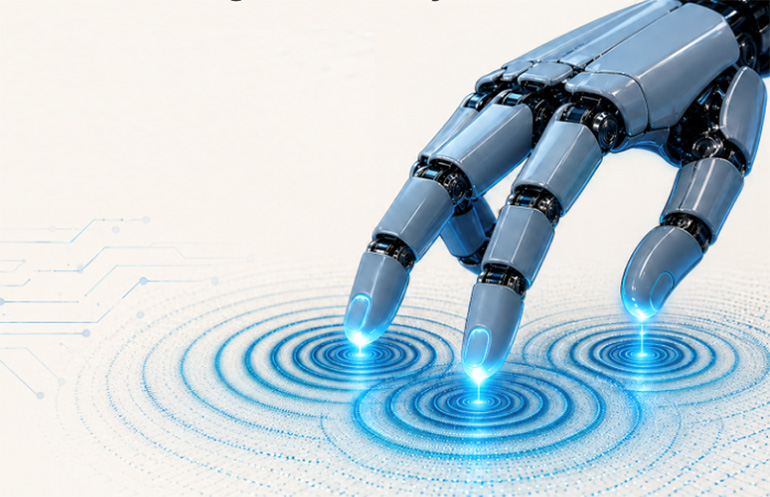
UltraSense says its sub-surface ultrasound tactile platform can sense through a protective outer layer, resolving features at 500 µm spatial resolution and force to roughly 1.25 mN.
Why it matters
Surface-coupled electronic skins sit in the harshest spot on a robot, where repeated compression and abrasion can cause drift and delamination — a problem over millions of contact cycles, the company argues.
What to watch
Whether ultrasound becomes the default tactile layer hinges on commercial robotic hands surviving long duty cycles without recalibration. UltraSense cites 4 million automotive units shipped as its manufacturing base.
WHO IT HITSRobotics hardware teams and integrators building humanoid hands, dexterous grippers, and logistics or service robots face a sensor-lifecycle decision; UltraSense is pitching protected sub-surface ultrasound to avoid the recalibration and replacement burden of surface electronic skin.
Ask the AI about this article →
Summaries like this, in your inbox every morning.
UltraSense is making its case as physical AI moves from digital reasoning into real-world interaction, where manipulation depends on reliable touch. The company argues the industry has largely converged on flexible electrical sensing layers — capacitive, piezoresistive, piezoelectric, triboelectric, and impedance-based structures — placed on or near the contact surface. Those approaches have advanced the field, but for high-duty-cycle robotic fingers and grippers the sensing layer sits in the harshest mechanical environment on the robot.
That environment includes repeated compression, abrasion, contamination, humidity, temperature variation, cleaning exposure, and material aging, which can introduce wear, hysteresis, and recalibration burden. UltraSense's alternative is to interrogate the material stack from below with acoustic waves, letting the outer surface handle friction, compliance, and sealing. The company says this approach can infer touch, force mapping, shear, slip, and even material type through acoustic impedance, and it points to its automotive HMI background and 4 million shipped units as evidence it can manufacture at scale.
Whether ultrasound becomes a foundational tactile layer for physical AI will likely hinge on whether commercial robotic hands can operate over millions of contact cycles without the drift and recalibration that plague surface-coupled skins. UltraSense's claims are its own, and the broader test is whether robot makers adopt protected sub-surface sensing as a standard architecture rather than a laboratory demonstration.
For example, today's edition would include:
AI-summarized, only the topics you pick — one digest a day via Email, Slack, or Discord.
Free · 30 seconds with Google · unsubscribe anytimeWhat is AIToday? →
Ask AI anything about this article. Q&As are published on this page for other readers too.
Mecka AI, which collects human motion data to train robots, is nearing a round led by Sequoia Capital at a val…

Caterpillar CEO Joseph E

Toyota Industries announced it will exhibit an autonomous forklift with a multi-load handler specification, bi…

FANUC announced on September 11 it developed an AI Welding Agent for arc welding

Mel Torrie, founder and CEO of Autonomous Solutions Inc., will lead a RoboBusiness session titled "Designing t…

Michael Mazur and Adam Wiśniewski, co-authors of PwC's 2016 "Clarity from Above," graded their $127.3 billion…


