What happened
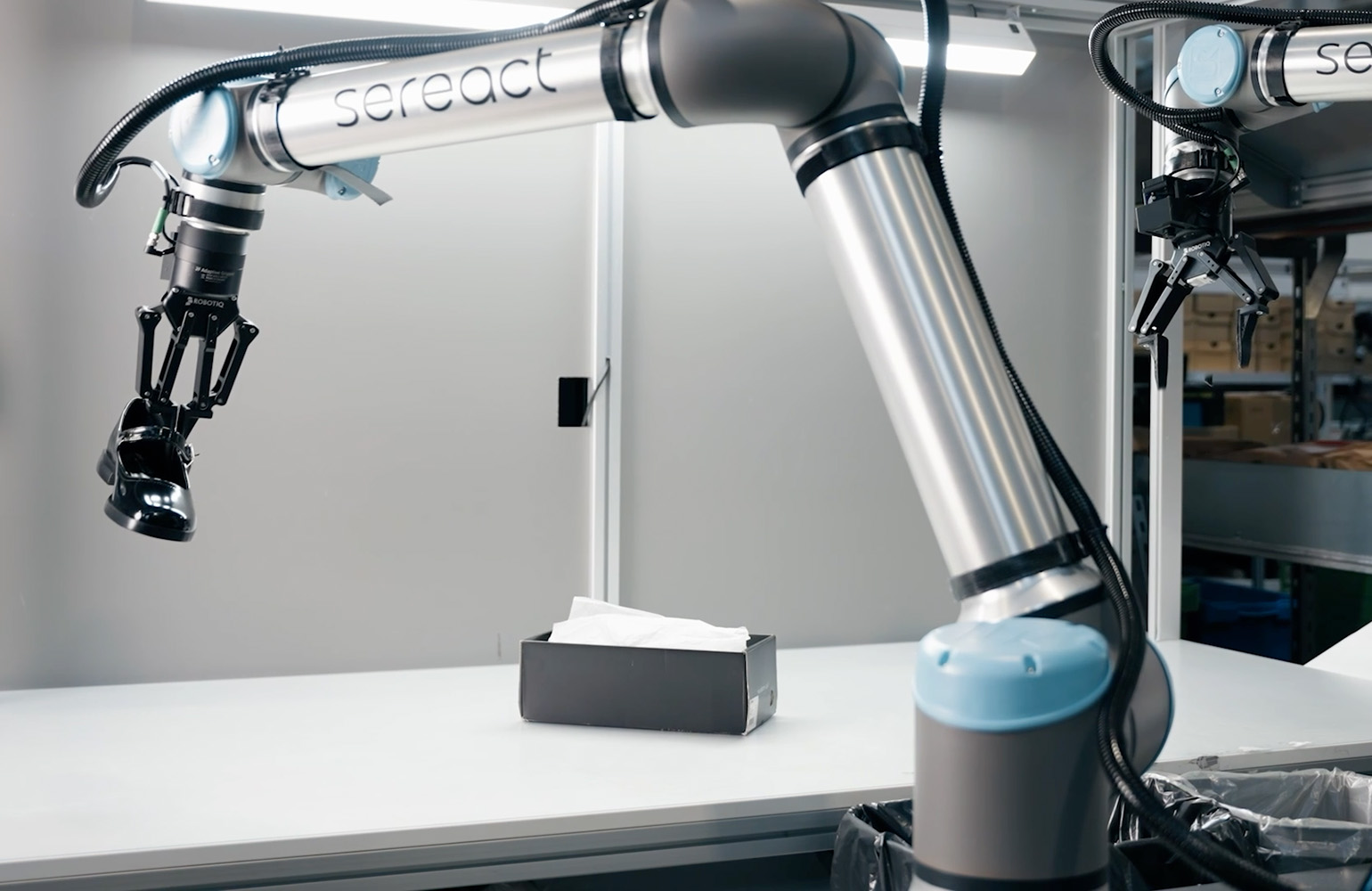
Teradyne Robotics partnered with Sereact to run Sereact's Cortex physical AI platform on Universal Robots arms; together they have shipped hundreds of UR robots in dual-arm systems to live customer sites across Europe.
Why it matters
The joint offering handles unstructured tasks such as returns handling and piece picking, and runs on one production model without retraining for each new item, according to Sereact CEO Dr. Ralf Gulde; the companies say it has moved beyond the demo or pilot stage.
WHO IT HITSRetailers and logistics providers handling returns and piece picking can now buy a combined robot-arm-plus-AI-software offering that the companies say is already deployed at live sites, reducing the need to build custom automation for each new item.
Summaries like this, every morning.
The partnership builds on work that was already underway rather than starting from scratch. Teradyne Robotics, which houses Universal Robots and Mobile Industrial Robots, is contributing its installed base of more than 100,000 industrial deployments, while Sereact brings software that lets robots handle items they have never encountered. The two companies chose NVIDIA GTC Berlin 2026 to announce the tie-up, and NVIDIA's simulation and computing tools sit underneath the demonstration: Cortex is trained in Isaac Sim with Cosmos world models, post-trained in Isaac Lab, and run at the line on Jetson Thor.
The first visible application is returns handling for Zalando through CEVA Logistics at fulfillment centers in Germany and Poland. Sereact CEO Dr. Ralf Gulde described returns as one of the hardest logistics jobs because items arrive in unpredictable shapes, orientations and packaging. Beyond that initial phase, the companies list piece picking, sortation, order induction, machine tending, bin consolidation, kitting, packing and goods handling as target use cases. Sereact's summer opening of a U.S. headquarters in Charlestown, Mass., signals an intent to extend the joint offering to North America, though the body does not give a timeline for those deployments.
Pick your industry and the AI tools you use, and get news related to your work every day.
Free · 30 seconds with Google · unsubscribe anytimeWhat is AIToday? →
Ask AI anything about this article. The AI reads this article, earlier AIToday articles, and Wikipedia, and cites its sources. Q&As are published on this page for other readers too.
Nvidia open-sourced Flora, a data engine of three fine-tuned Qwen3.5 models that covers all three label types…
After GPT-6 Astra launched in early September 2026, researchers ran it through Physical AI and robotics benchm…
Namuga secured a supply deal with a global humanoid robot company and is preparing shipments and mass producti…
Sony Innovation Fund Senior Investment Director Kei Furukawa said the fund has backed roughly 220 startups wor…
Eka Robotics said this week it raised $150 million in Series A funding, led by Andreessen Horowitz and F-Prime…
Warp Sciences, an AI-and-robot chemistry CRO led by ex-OpenAI product chief Kevin Weil, launched on the 22nd w…