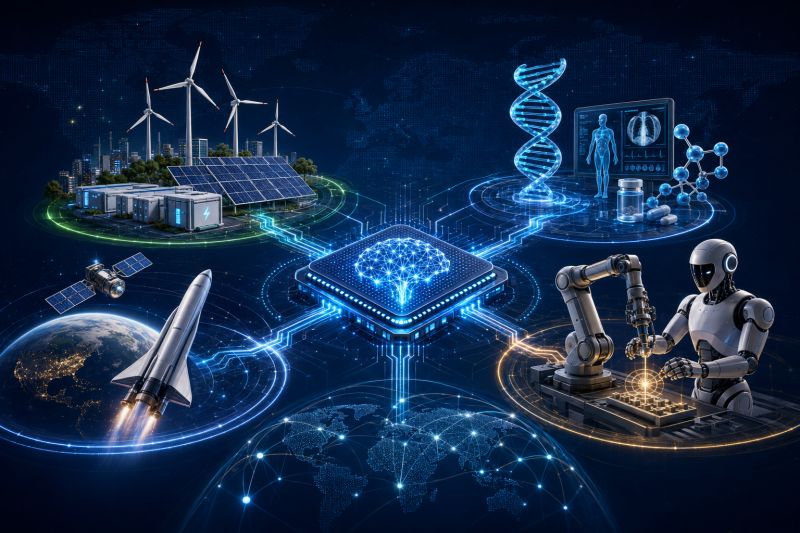
The IEEE's Technology Megatrends 2030 report ranks physical AI and robotics among the five breakthrough areas most likely to reshape industries by 2030, with advances in human-AI interaction—combining speech, video, perception, and cognitive capabilities—serving as a key enabler.
However, deploying intelligent machines in physical environments raises critical challenges around safety, cybersecurity, and trust, with power delivery identified as the largest technical hurdle for widespread commercial robot deployment outside controlled manufacturing settings.
What happened
The IEEE's Technology Megatrends 2030 report identifies physical AI and robotics as one of five core breakthrough areas expected to reshape industries and daily life by 2030, alongside AI, energy, health and biotechnology, and space technology. The report examines 30 breakthrough technologies overall. Dejan Milojicic, chair of the IEEE Future Directions Committee Industry Advisory Board and an HPE Fellow, highlights human-AI interaction—moving beyond text toward speech, video, perception, and cognitive capabilities—as a key enabler of physical AI advancement.
Why it matters
Physical AI systems that perceive, interact with, and act in the physical world could make industrial robots and autonomous machines easier to supervise, teach, and collaborate with, with potential applications in manufacturing, healthcare, transportation, and agriculture. However, deploying intelligent machines in physical environments raises critical questions around reliability, cybersecurity, safety, and trust—particularly when AI systems make decisions affecting people, equipment, and infrastructure. Milojicic notes that power delivery remains the largest hurdle for broader commercial robot deployment, except in manufacturing where robots can stay continuously connected to a power source.
What to watch
Constrained use cases in manufacturing, healthcare, and agriculture are expected to advance first, followed by expansion as behaviors, risks, and opportunities become better understood. Military applications are already advancing rapidly, driven by substantial funding and demand. The industry's biggest cybersecurity vulnerability, according to Milojicic, lies in security exploits and power supply systems; backup solutions will be required given the growing power demand and dependency of AI factories.
The IEEE's Technology Megatrends 2030 report, examined through an interview with Dejan Milojicic—chair of the IEEE Future Directions Committee Industry Advisory Board and an HPE Fellow at Hewlett Packard Labs—positions physical AI and robotics as the technology area most likely to see major advances over the next four years. The broader report evaluates 30 breakthrough technologies across five core areas: artificial intelligence, energy, health and biotechnology, space technology, and physical AI, assessing how they could reshape industries and human life by 2030.
The acceleration in physical AI potential stems primarily from advances in AI itself, which Milojicic identifies as the primary driver enabling many other breakthroughs. AI is making cybersecurity much more effective, reliable, and trustworthy, while also improving energy efficiency—though energy consumption remains a major challenge at scale. In robotics specifically, AI enables new collaborative algorithms. At the same time, non-AI advances in materials and sensors continue, with AI increasingly supporting these areas by accelerating design space exploration. The report highlights human-AI interaction as a key enabler of physical AI development. Rather than relying solely on voice commands or natural language processing, effective interaction will increasingly combine video recognition with cognitive capabilities layered on top—such as anticipation—that allow machines to better understand human intent and support human movement. Milojicic notes that sensors on the human body could further accelerate interaction, though brain-computer interfaces remain in an early phase and are unlikely to be practical in the near term.
When asked which robotics sectors are likely to achieve widespread commercial deployment first, Milojicic points to constrained use cases in safe environments as accelerators for near-term development. Autonomous robots were initially applied at airports and in manufacturing within very constrained spaces and limited options; over time, more degrees of freedom were added as behaviors, risks, and opportunities became better understood. Today, robotics is advancing at a rapid pace, with military use cases among the most promising applications, both driven by strong demand and substantial funding levels. However, power delivery remains the largest hurdle for broader commercial use, except in manufacturing environments where robots can remain continuously connected to a power source. For wider deployment beyond factories, power is described as a "hard limitation."
Balancing AI flexibility with industrial safety is a central challenge. Milojicic acknowledges this as an "extremely well-posed question that reflects exactly what is going on." With deployment experience, developers and operators will gain trust and remove obvious safety hazards; as trust increases, more autonomous operations will be permitted. Improved human-AI interfaces will enable stronger human-in-the-loop oversight, reducing the risk of disruption from unexpected events. On cybersecurity, Milojicic foresees that security exploits will be the initial vulnerability. While AI can be used both to find and prevent exploits, the industry will eventually reach a point where only complex and costly exploits remain. A prominent target is power supplies; therefore, backup solutions will be required to provide continuous supply. He notes that while such solutions existed in the past—generators provided uninterruptible services to hospitals—the power demand and dependency of AI factories is now surpassing these previous cases.
Regarding employment, Milojicic believes both job augmentation and job displacement will occur. "Humanity, especially the workforce, will have to adjust, as they did during every previous technology revolution." This current transition is developing the fastest and could have the broadest impact. Blue-collar jobs have been historically affected; white-collar roles are increasingly targeted. Any profession that could be automated using AI is possibly a target. Companies are reporting almost daily restructuring—whether by replacing roles with AI, repositioning for future opportunities, or redirecting resources toward building AI infrastructure. However, Milojicic suggests relief may come when the race for AI infrastructure reduces the cost of services—citing tokens used in large language models as an example—further reducing the need for layoffs. Both employees and employers continue to evaluate which jobs will disappear, emerge, or transform.
The IEEE's positioning of physical AI as a top megatrend reflects a fundamental shift in AI research and deployment. While generative AI has dominated technology discourse in recent years, the report signals that the next major phase will focus on systems that interact with and act in physical environments—a transition made possible by advances in AI itself. According to Milojicic, AI has been the primary driver enabling many other breakthroughs, from improving cybersecurity and energy efficiency to enabling new collaborative robotics algorithms. Importantly, non-AI advances in materials and sensors continue, but AI accelerates design exploration in these areas as well.
The emphasis on human-AI interaction as a critical enabler reflects a pragmatic understanding that robots and autonomous systems must work alongside humans, not replace them entirely—at least initially. Video recognition coupled with cognitive capabilities like anticipation will be particularly important for industrial robots. Milojicic notes that constrained environments—manufacturing with continuous power, healthcare, and agriculture—offer the safest proving grounds for early deployment, a strategy echoing how autonomous robots first appeared at airports and in tightly controlled factory spaces before expanding to less predictable settings.
The report's focus on trustworthy AI, cybersecurity, and safety acknowledges real vulnerabilities. Milojicic identifies security exploits and power supply integrity as the industry's most pressing concerns, particularly as AI factories' power dependency outpaces precedent. The challenge of balancing AI flexibility with industrial safety and regulatory compliance—a question Milojicic describes as "extremely well-posed"—will likely define how quickly deployment accelerates. He suggests trust will grow incrementally through deployment experience, allowing more autonomous operations as developers and operators build confidence and remove low-hanging safety hazards.
AI-summarized, only the topics you pick — one digest a day via Email, Slack, or Discord.
Free · takes 30 seconds · unsubscribe anytime
Ask AI anything about this article. Q&As are published on this page for other readers too.
Google and Cleveland Clinic announced a partnership to develop AI-powered robotic systems designed to improve…

Archer Aviation is acquiring Boeing subsidiaries Wisk Aero, SkyGrid, and Insitu, expected to close by end of 2…

Archer Aviation announced a deal with Boeing to develop physical AI applications for the aerospace and defense…

Archer Aviation announced it will acquire three Boeing subsidiaries—Wisk Aero (eVTOL aircraft), Insitu (unmann…

An autonomous robot called temi, paired with a no-code programming app called Buddiotte and integrated support…

AES's Maximo, an AI-powered robotic system, has installed more than 180,000 solar modules representing more th…

The AI news that matters, in one minute each morning.
Sign up free