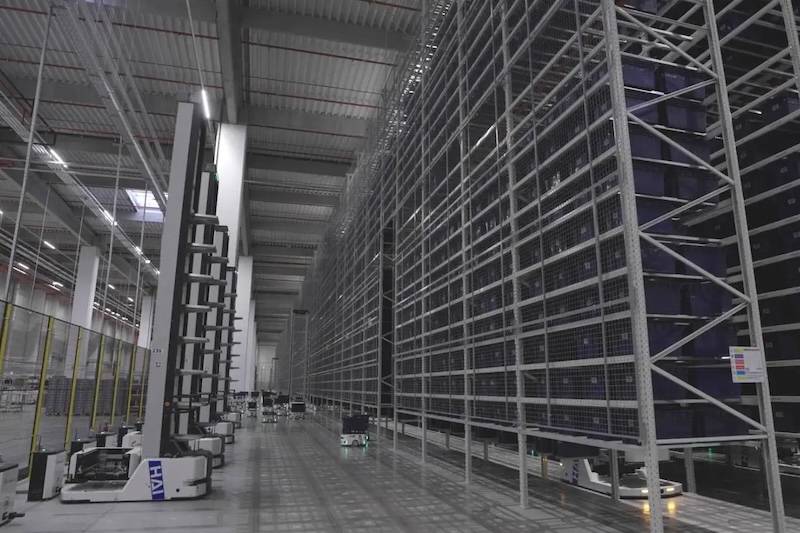
LPP Logistics has deployed nearly 950 robots at its new fulfillment centre near Bucharest to handle e-commerce growth across Southeastern Europe. The system combines automated case-handling robots and autonomous mobile robots to store up to 7.5 million items and process over 80,000 customer orders daily while improving picking productivity and enabling future expansion without major overhauls.
Summaries like this, in your inbox every morning.
Sign up free →What happened
LPP Logistics, the logistics arm of fashion retailer LPP Group, deployed Hai Robotics' HaiPick System 3 at its new fulfilment centre near Bucharest, Romania. The system combines 278 automated case-handling robots with 670 autonomous mobile robots, providing over 625,000 automated storage locations with capacity to store up to 7.5 million garments and accessories.
Why it matters
The installation addresses rising e-commerce order volumes across Southeastern Europe (Romania, Bulgaria, Serbia, Greece, and Hungary) while allowing LPP Logistics to expand capacity without disrupting operations. The system reduces warehouse operators' walking distance by bringing storage containers directly to picking stations, improving picking productivity and workflow consistency.
What to watch
The facility can process more than 80,000 customer orders each day and handle more than 9,400 totes per hour. The centre was designed with scalability in mind, allowing additional robots and workstations to be added as demand increases without major infrastructure changes. Deployment took less than six months.
LPP Logistics, the logistics division of Central European fashion retailer LPP Group, has deployed Hai Robotics' HaiPick System 3 at its new fulfilment centre near Bucharest, Romania. The project supports the retailer's growing e-commerce operations across Southeastern Europe, serving Romania, Bulgaria, Serbia, Greece, and Hungary. LPP Group operates five fashion brands—Reserved, Cropp, House, Mohito, and Sinsay—and expanded its logistics network in response to increasing online demand and a growing product range.
To meet rising order volumes and support an expanding number of stock keeping units (SKUs), LPP Logistics deployed a goods-to-person automation system combining 278 HaiPick automated case-handling robots (ACRs) with 670 companion autonomous mobile robots (AMRs). The installation provides more than 625,000 automated storage locations with capacity to store up to 7.5 million garments and accessories. Deployment took less than six months, allowing the operation to expand fulfilment capacity while maintaining operational continuity.
The system fundamentally changes warehouse operations by bringing storage containers directly to picking stations, eliminating the need for operators to walk long distances to retrieve inventory. This reduces walking time, improves picking productivity, and creates a more consistent workflow. The HaiPick System 3 installation is capable of handling more than 9,400 totes per hour, while the fulfilment centre itself is designed to process more than 80,000 customer orders each day, supported by automated sortation capable of handling up to 14,000 parcels per hour.
The facility was designed with scalability in mind. Additional robots, workstations, and throughput capacity can be added as demand increases, allowing the operation to expand without major infrastructure changes. According to Hai Robotics, LPP Logistics selected the company not only for its automation technology but also for its collaborative approach to designing a fulfilment system tailored to the retailer's operational requirements and long-term growth plans. The project illustrates how goods-to-person robotics is becoming an increasingly common approach to warehouse automation as retailers seek greater flexibility than conventional fixed automation systems can provide.
LPP Logistics operates five fashion brands—Reserved, Cropp, House, Mohito, and Sinsay—and faces typical challenges of modern e-commerce: rising order volumes, expanding product ranges across multiple sizes and colours, and pressure to maintain speed and accuracy. Traditional warehouse designs struggle to balance high inventory density with rapid product access, forcing retailers to choose between storage capacity and picking efficiency.
Hai Robotics' goods-to-person approach inverts this trade-off by having robots deliver storage containers to stationary picking stations rather than requiring operators to travel long distances through the warehouse. This reduces manual labour, improves workflow consistency, and allows the facility to pack far more inventory into the same building footprint. The Romanian deployment demonstrates how this model is becoming standard across European distribution centres facing mounting e-commerce pressure.
AI-summarized, only the topics you pick — one digest a day via Email, Slack, or Discord.
Free · takes 30 seconds · unsubscribe anytime
No comments yet. Be the first to share your thoughts!
Log in to join the discussion




Get curated AI news from 200+ sources delivered daily to your inbox. Free to use.
Get Started FreeFree · takes 30 seconds · unsubscribe anytime
