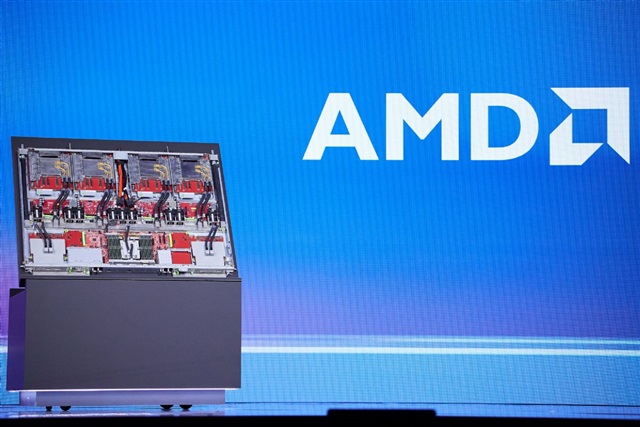
AMD is advancing its Helios chip and ROCm software as a challenger to Nvidia's dominant CUDA platform for AI infrastructure. The market is shifting focus from GPU performance alone to evaluating entire computing systems, creating an opening for AMD to capture market share if it can solve two key challenges: ensuring ROCm stability at scale and meeting Helios production and delivery timelines.
Summaries like this, in your inbox every morning.
Sign up free →What happened
AMD is positioning its Helios chip and ROCm software stack as an alternative to Nvidia's CUDA-based AI infrastructure, as the market shifts from evaluating GPUs alone to assessing entire computing systems.
Why it matters
AMD has an opportunity to convert software improvements into market share as customers reassess their AI infrastructure choices beyond raw GPU performance. For enterprises and cloud providers, viable alternatives to Nvidia could reshape procurement decisions and reduce dependency on a single supplier.
What to watch
Two critical unknowns will determine whether AMD can gain traction: whether ROCm can run stably in large clusters, and whether Helios can enter mass production and ship on time.
AMD is leveraging a shift in how the market evaluates AI infrastructure to mount a serious challenge to Nvidia's entrenched position. Historically, Nvidia's CUDA platform has defined the standard for AI workloads, and customers have optimized around GPU specifications and performance metrics. However, as AI deployments move from research environments to large-scale production clusters, the calculus is changing. Enterprises and cloud providers increasingly recognize that the entire computing system—not just the GPU—determines performance, cost, and operational reliability.
AMD's Helios chip and ROCm software stack are positioned as a complete alternative. For customers evaluating options, the potential benefit is substantial: reduced lock-in to Nvidia's ecosystem, potential cost savings, and genuine competition that could improve pricing and service across the board.
Yet two concrete hurdles must be cleared before Helios can meaningfully alter the competitive landscape. First, ROCm must prove it can run stably in large clusters. In research and small-scale deployments, software can be matured gradually, but production clusters at the scale major cloud providers and enterprises operate require bulletproof reliability—crashes or performance degradation that affect thousands of users are unacceptable. Second, Helios must successfully transition to mass production and meet its shipping schedule. Missing deadlines or facing manufacturing constraints would undermine AMD's credibility and allow Nvidia additional time to strengthen its position.
The AI infrastructure market is undergoing a structural shift. Rather than customers choosing hardware based solely on GPU performance, procurement decisions now hinge on the entire computing system—including software stability, integration, and reliability at scale. This shift creates an opening for AMD to compete where Nvidia has historically held dominance through its mature CUDA ecosystem. However, the article makes clear that AMD's success depends on two execution challenges that go beyond technical specification sheets: whether its ROCm software can maintain stability when deployed across large clusters (a real-world constraint that academic benchmarks may not fully capture), and whether Helios can transition from development to mass production without delays. Both challenges are as much about manufacturing readiness and operational maturity as they are about raw engineering capability.
AI-summarized, only the topics you pick — one digest a day via Email, Slack, or Discord.
Free · takes 30 seconds · unsubscribe anytime
No comments yet. Be the first to share your thoughts!
Log in to join the discussion


Get curated AI news from 200+ sources delivered daily to your inbox. Free to use.
Get Started FreeFree · takes 30 seconds · unsubscribe anytime
