What happened
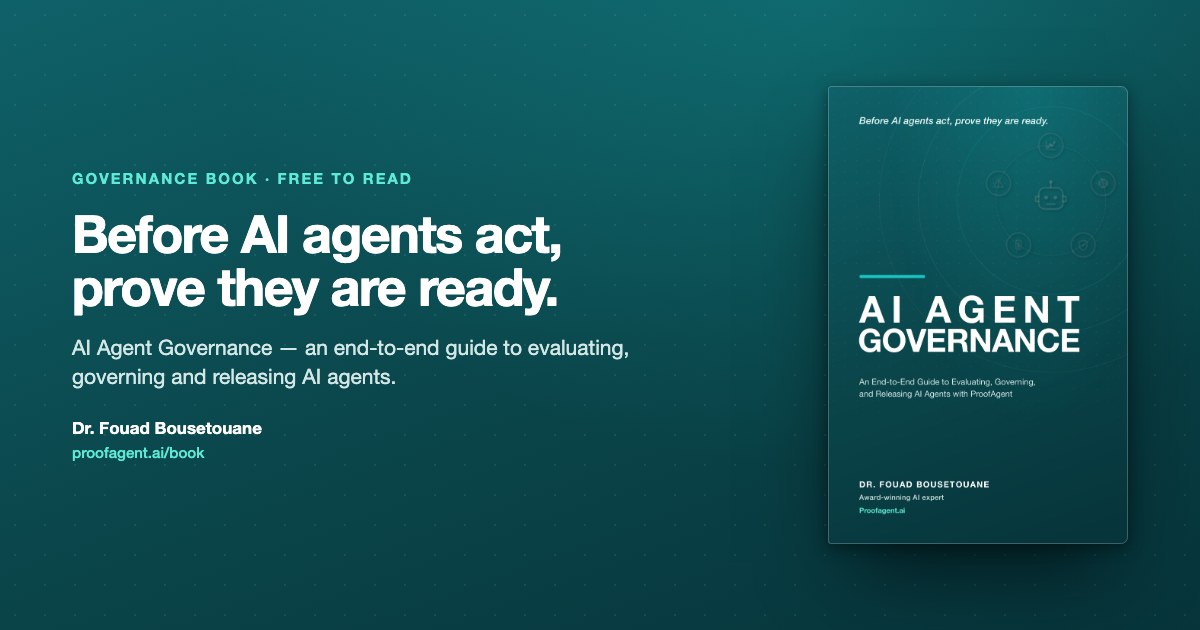
A free 154-page guide titled "AI Agent Governance" by Dr. Fouad Bousetouane has been published, offering a practical framework for evaluating and releasing AI agents to production. The book covers seven parts, from understanding agents in production through compliance controls, release decisions, and continuous assurance.
Why it matters
Organizations deploying AI agents face a governance gap—no standardized approach exists for deciding when an agent is production-ready or how to defend that decision to auditors. This guide provides a mental map spanning four layers of evidence and four dimensions of readiness, turning requirements into testable controls and evaluation findings into defensible release decisions. For teams managing agent deployments, it may help reduce the ambiguity and liability around agent behavior verification.
What to watch
The book is free to read and includes an end-to-end workflow (eleven stages) applied to a single agent, plus two real-world use cases—a Financial Operations Assistant (which can move money) and a Media and Research Assistant (governed at a lower tier)—showing how the same governance method scales to different risk levels.
Summaries like this, in your inbox every morning.
The publication of this free governance guide reflects a practical gap emerging as organizations move from experimenting with AI agents to deploying them at scale. The guide's emphasis on turning evaluation findings into testable controls and defensible release decisions addresses a real need: when an agent that "advises" becomes an agent that "acts" (such as one that can move money), the stakes for governance rise sharply. The seven-part structure—from understanding the agent's anatomy, through risk ownership and evaluation, to compliance controls and continuous assurance—suggests that governance is not a one-time release check but an ongoing accountability cycle. The inclusion of two contrasting use cases (a high-stakes financial assistant and a lower-tier media assistant) indicates that the same governance method can be calibrated to different risk levels, which is likely to be useful for organizations managing multiple agents with varying stakes.
Pick your industry and the AI tools you use, and get news related to your work every day.
Free · 30 seconds with Google · unsubscribe anytimeWhat is AIToday? →
Ask AI anything about this article. The AI reads this article, earlier AIToday articles, and Wikipedia, and cites its sources. Q&As are published on this page for other readers too.
Anthropic says its defenses cut extracted reasoning tokens to between one-tenth and one-hundredth of prior lev…

Terence Tao gave a Caltech lecture on October 9, 2026, and posted it the next day, proposing "Math 2.0" — use…

KiteRa's survey of 1,206 employees at AI-agent-using companies found 13.4% had experienced policy or legal vio…

Anthropic's Frontier Red Team said models of 30B parameters or fewer could self-replicate on everyday IoT devi…
At TOKEN2049 in Singapore, Nansen CEO Alex Svanevik told Fortune that by 2028, trading with agents will be the…

Dell's Helen O'Sullivan said Bay Area customers are exhausting token budgets allotted for months within a matt…