What happened
NVIDIA said it plans to spend $12.9 billion, the largest acquisition in its history, to buy Hugging Face, where developers pick and ship models.
Why it matters
Owning that model marketplace lets NVIDIA sit underneath rivals' costs regardless of whose chip wins, according to the author — not defense but an exit ramp back to it.
What to watch
The claim hinges on custom chips taking years to match CUDA's volume, yield and software maturity, so NVIDIA's grip is likely to persist for now.
WHO IT HITSThe deal lands hardest on developers and platform teams choosing where to fine-tune and deploy models, and on enterprise AI buyers weighing whether their stack stays portable across chips and clouds. It also bears on governments pursuing sovereign AI, who may find the neutral marketplace they rely on now owned by a chip vendor — a tension the article frames as unresolved.
Summaries like this, in your inbox every morning.
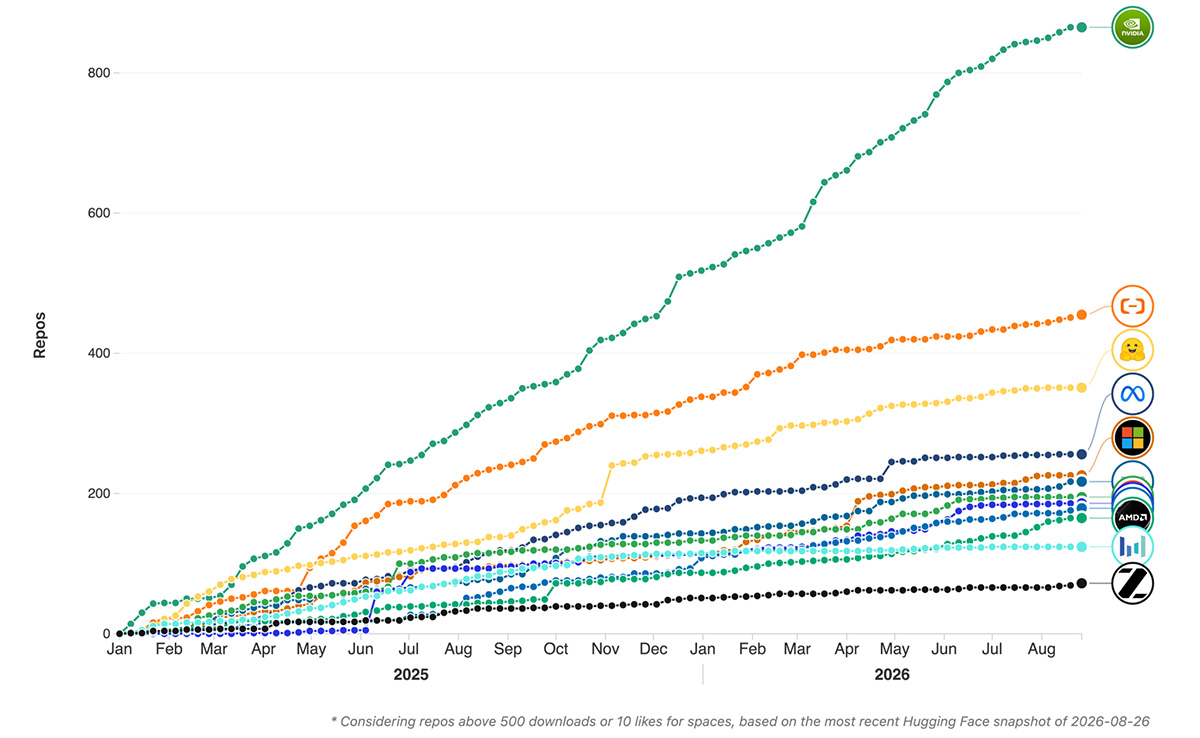
The article sets NVIDIA's move against a run of announcements from developers trying not to depend on it: OpenAI shipped its own chip, Anthropic stood up an in-house silicon team, and AMD, Qualcomm, Skild AI and Google DeepMind all made their own physical-AI moves. The author's argument is that these efforts target the wrong layer — the chip — while NVIDIA quietly bought the layer where models are actually found, fine-tuned and shipped. The numbers cited to support that view are less about raw performance than about maturity: OpenAI's Jalapeño, built with Broadcom over nine months, is called a narrow inference chip for OpenAI's own workloads, and Anthropic's silicon team is described as a hiring page with a mission statement. Against that, the article notes NVIDIA says it has the most repos and the second-most homegrown models on Hugging Face.
The word the author keeps returning to is "sovereign." Governments spending public money on AI independence do not want to bet national compute on any single lab's chip, and NVIDIA's pitch is that it is neutral — pick any model, framework or cloud. The article's reading is that this neutrality is exactly what the Hugging Face acquisition undermines, since the place where all those choices live would now belong to the same company. In robotics, the stakes sharpen because local inference and real-time control are operational requirements, not slogans, and whoever owns the training stack, simulation environment and edge runtime sets the terms for how physical intelligence gets deployed.
Whether that matters as much as the author suggests depends on how quickly custom silicon closes the gap in volume, yield and software maturity — a gap the article itself calls years wide. For application-layer builders, the practical question is whether portability across models and compute holds up regardless of whose logo sits on the silicon; for governments and large buyers, it is whether a marketplace owned by a chip vendor can still be treated as neutral ground.
Pick your industry and the AI tools you use, and get news related to your work every day.
Free · 30 seconds with Google · unsubscribe anytimeWhat is AIToday? →
Ask AI anything about this article. The AI reads this article, earlier AIToday articles, and Wikipedia, and cites its sources. Q&As are published on this page for other readers too.
Alon Horev, co-founder and CTO of Vast, said at Fully Connected 2026 that agent sessions of half a million tok…
MasterClass Executive, MasterClass's new AI-native business program, runs a multi-agent system using about 10…
Taiwan's National Science and Technology Council (NSTC) has issued a call for proposals on "high-performance p…

Microsoft, Amazon, and Oracle disclosed huge contracted AI cloud backlogs: Azure at roughly $100 billion a yea…

Overview AI launched the OV Spark and OV Spark Pro, all-in-one inspection cameras with an onboard agent called…
Microsoft published Nobel Prize-winning economist Daron Acemoglu's forecast that AI will boost GDP by about 1.…