What happened
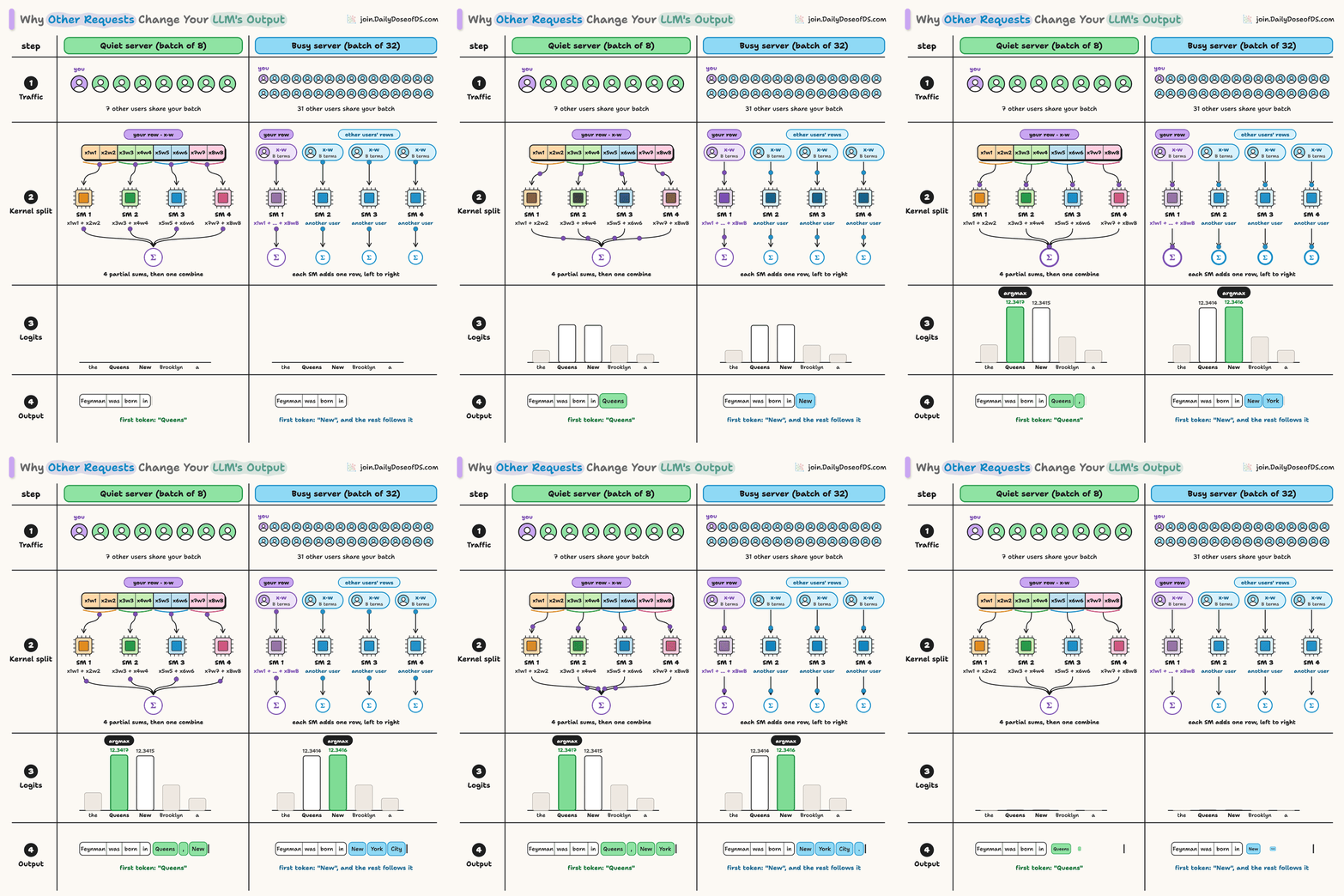
Thinking Machines Lab ran 1,000 completions of "Tell me about Richard Feynman" from Qwen3-235B at temperature 0 and got 80 unique completions; all matched for 102 tokens, then 992 continued with "Queens, New York" and 8 with "New York City".
Why it matters
Temperature 0 does not make inference deterministic, because the sampler is deterministic but reads logits from a forward pass whose numerics depend on traffic the user does not control, so the same prompt can diverge at a nearly tied token.
Summaries like this, every morning.
The finding matters because it undercuts a common assumption: that setting temperature to 0 guarantees the same answer every time. In practice, the sampler is deterministic, but the numbers it samples from differ with the batch around the request. When two candidate tokens are nearly tied, such as "Queens" and "New" at 12.3417 and 12.3415, a tiny rounding shift can flip the greedy choice and send the whole completion down a different path.
The effect traces to how GPU kernels pick a parallelization strategy. A small batch does not give all 132 SMs on an H100 SXM enough work, so long sums are split across SMs and added back together in a different order than a large batch would use. The same three fp16 numbers can produce 1024 or 1025 depending on which pair is added first.
The practical response is a batch-invariant kernel, which reduces each row in the same fixed order no matter how many rows share the batch. This restores identical logits across batch sizes but costs throughput because the kernel can no longer pick the best split per batch size. With this on, Thinking Machines got all 1,000 Feynman completions identical.
Pick your industry and the AI tools you use, and get news related to your work every day.
Free · 30 seconds with Google · unsubscribe anytimeWhat is AIToday? →
Ask AI anything about this article. The AI reads this article, earlier AIToday articles, and Wikipedia, and cites its sources. Q&As are published on this page for other readers too.
Anthropic told API customers it will watermark Claude Mythos 5, Claude Opus 4.7, Claude Opus 4.6, and Claude S…
A walkthrough wires the open-source Hindsight memory system (vectorize-io, MIT license) into a plain Claude AP…

Given a roughly 8,400-character Japanese article and told to summarize it in 3–5 bullet points, gemma4:e4b res…

The book documents a working kit for scheduled Claude Code runs — a starter, task instructions, a STATE.md kep…

OpenAI told Trusted Access members that from November 29, Daybreak Blue session data will be used for training…

Arca, which recently raised $48.5 Million led by General Catalyst, built its own agent harness and a per-clien…