AIToday
RoboticsAutonomous DrivingArs Technica AIPublished: Aug 8, 2026, 22:01 JST4 min read

Mars rover Perseverance thriving after years of autonomous exploration

Mars rover Perseverance thriving after years of autonomous exploration

Key takeaway

  • NASA's Perseverance rover is performing well on Mars after several years of autonomous exploration, with improved wheel design avoiding the wear problems that affected the earlier Curiosity rover.

  • The vehicle is investigating ancient rocks in Jezero Crater dating back about 4 billion years to understand whether Mars once had conditions suitable for life, including possible lakes or oceans.

  • Because Perseverance operates on nuclear power without consumables or lubricants, it could keep driving for many years to come.

3 Key Points

  1. What happened

    NASA's Perseverance rover continues to operate successfully on Mars, with redesigned wheels showing no significant wear after years of driving, unlike its predecessor Curiosity which experienced notable wheel damage after nearly 15 years.

  2. Why it matters

    Perseverance is investigating 4-billion-year-old rocks in Jezero Crater during Mars's heavy bombardment era, when the planet may have hosted lakes or oceans and conditions potentially suitable for life—research that would be impossible without a functional, long-lived rover.

  3. What to watch

    NASA is certifying the rover's wheel actuators, originally life-tested for 20 km of driving, to operate for at least 100 km and possibly longer; since Perseverance runs on RTG power with no consumables requiring resupply, it could continue autonomous driving for many years.

In Depth

Read the full story

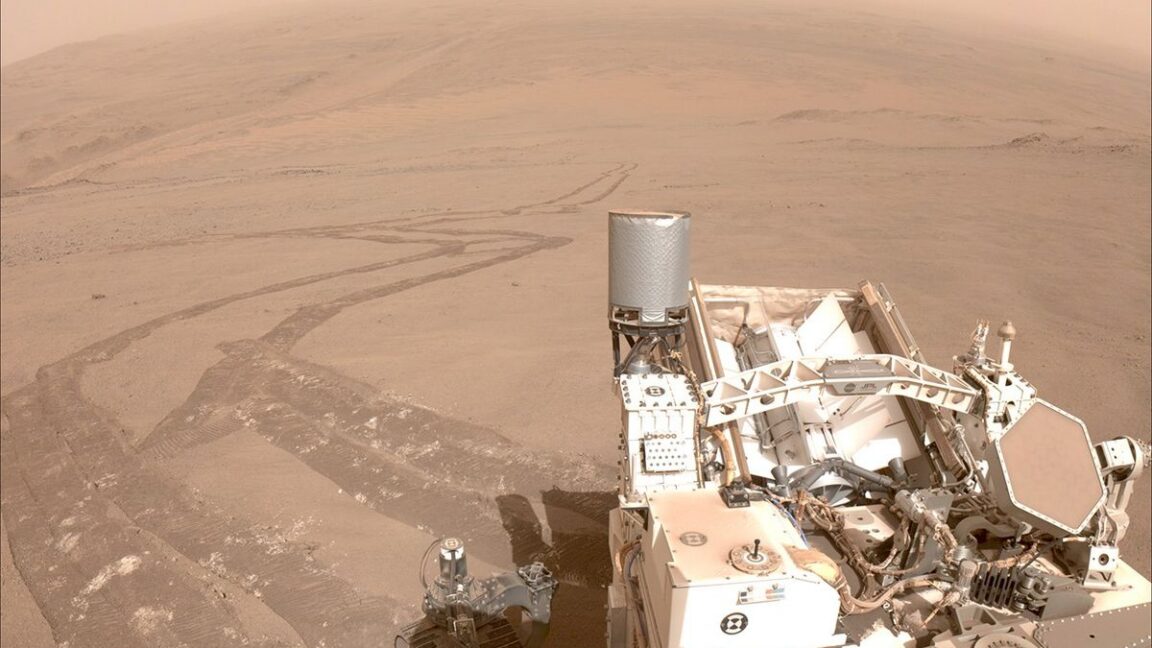
NASA's Perseverance rover is proving to be a robust successor to Curiosity, the earlier Mars rover that has now operated for nearly 15 years. Perseverance operators report that the vehicle is performing well, with a critical difference from its predecessor: the wheels, which were redesigned specifically to address durability problems Curiosity encountered. After years on Mars, Curiosity's wheels showed significant wear and tear, prompting engineers to rethink the design. Perseverance's new wheels have remained durable, exhibiting no signs of appreciable wear and tear to date.

The rover's mission centers on Jezero Crater, where it is studying some of the most ancient rocks in the Solar System—specimens dating back about 4 billion years, older than any on Earth. During that era, known as the heavy bombardment period, Mars was in a transitional phase when large numbers of rocks were still circulating through the inner planets, but the planetary system was beginning to stabilize. Evidence suggests that large lakes and possibly even oceans existed on Mars at this time. By investigating this ancient terrain in situ—the first time humans have been able to do so—scientists hope to reconstruct the geological and environmental conditions of early Mars and assess how conducive the planet might have been to life. One researcher involved in the mission noted the excitement of this direct investigation: "It's the first time we've been able to investigate this terrain in situ, and that's been very exciting." Scientists debate Mars's past appearance, with some comparing it to Earth's Mojave Desert, featuring water flowing through an arid landscape, though the full picture remains contested.

The durability advantage stems partly from Perseverance's power architecture. The rover operates on RTG (radioisotope thermoelectric generator) power and carries no propellants, consumables, or lubricants on board. This design means the vehicle does not degrade in the ways fuel-dependent systems would, enabling it to sustain operations indefinitely absent component failure. The only current concern involves the wheel actuators, which were initially life-tested for 20 km of driving. NASA is now in the process of certifying them to function for at least 100 km, and possibly longer. With successful certification, Perseverance could continue autonomous driving across Mars for many years to come, far exceeding the typical deep-space mission duration.

Context & Analysis

Perseverance represents a significant engineering advance over Curiosity, particularly in durability. Curiosity, which has operated for nearly 15 years, experienced substantial wheel wear that prompted engineers to redesign the wheels for its successor. The new design has proven successful, showing no appreciable wear after years of Martian exploration—a critical improvement for a vehicle operating in an environment where repairs are impossible. This durability matters because Perseverance's scientific mission depends on sustained mobility across terrain that is geologically rich but scientifically challenging to access. The rover's power source—a radioisotope thermoelectric generator (RTG)—means it does not rely on consumables like fuel or lubricants, removing a major operational constraint. NASA's ongoing certification effort to extend the wheel actuators' rated lifespan from 20 km to at least 100 km suggests confidence in the rover's long-term prospects and reflects the engineering team's commitment to maximizing the vehicle's productive life.

FAQ

How does Perseverance avoid the wheel damage that affected Curiosity?
The wheels were redesigned for Perseverance and show no signs of appreciable wear and tear, unlike Curiosity's wheels which experienced significant damage after nearly 15 years of operation.
What is Perseverance studying on Mars?
Perseverance is investigating ancient rocks in Jezero Crater dating back about 4 billion years, during the heavy bombardment era when Mars may have hosted large lakes and possibly oceans, to understand whether the planet could have supported life.
How long can Perseverance continue operating?
Because the rover operates on RTG power and has no propellants, consumables, or lubricants on board, it could keep driving itself across Mars for many years to come; NASA is certifying its wheel actuators to operate for at least 100 km and possibly longer.
Ars Technica AIRead Original Article

Get the latest Robotics news every morning

AI-summarized, only the topics you pick — one digest a day via Email, Slack, or Discord.

Free · takes 30 seconds · unsubscribe anytime

Ask AI

Ask AI anything about this article. Q&As are published on this page for other readers too.

Related Articles

Next articleGoogle Makes Gemini Hard to Hide in Docs, Docs

The AI news that matters, in one minute each morning.

Sign up free