What happened
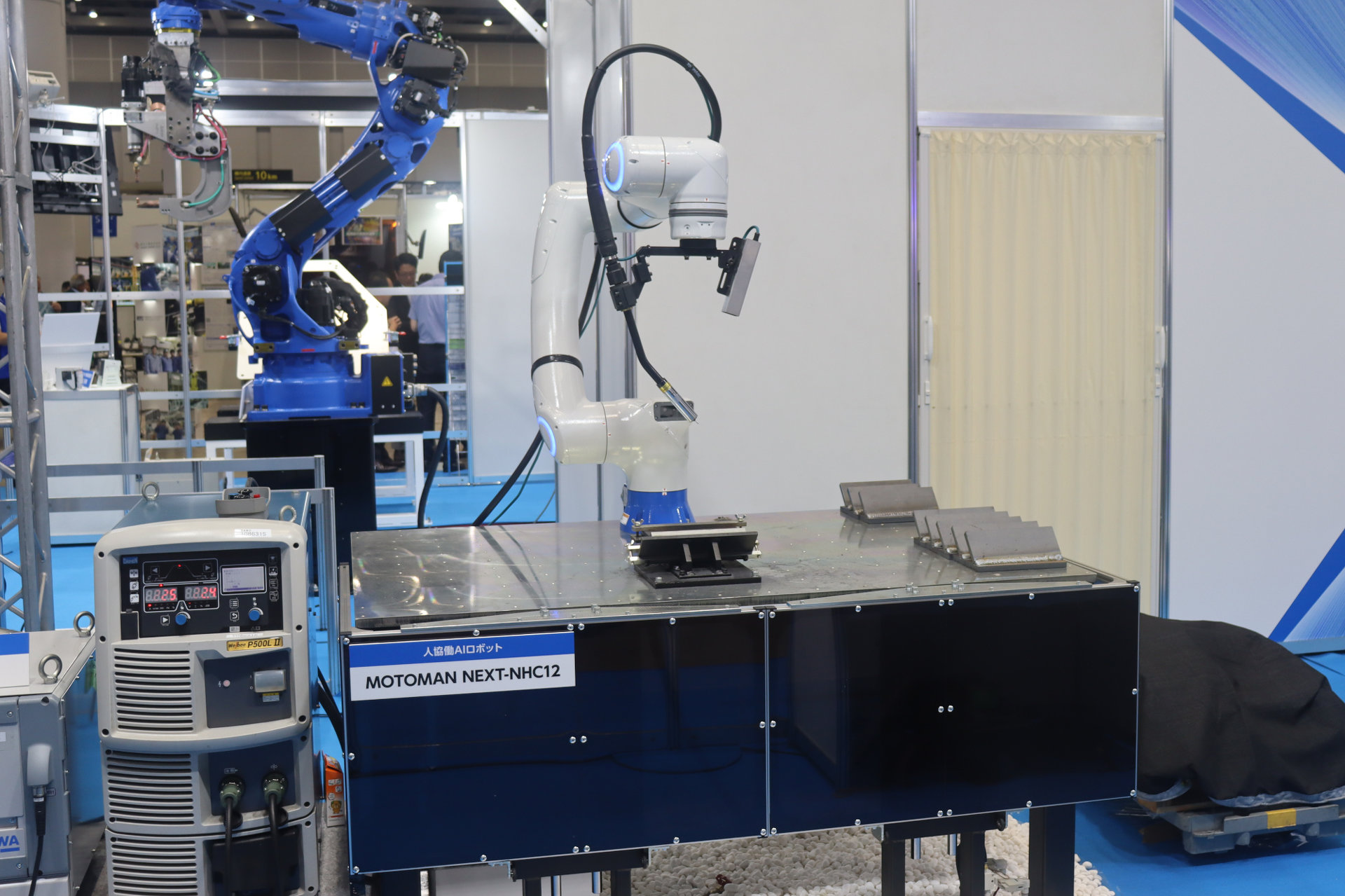
At the 2026 International Welding Show (Sept 16–19, Beijing), Yaskawa demonstrated its MOTOMAN NEXT-NHC12 robot welding 12mm thick steel with a camera-guided AI model adjusting motion and speed.
Why it matters
The demo suggests AI robots may reproduce the sensory skill that skilled welders rely on, potentially easing a welder shortage the body says is worsening.
What to watch
Yaskawa aims to link welding results with pre-weld inspection data and feed them back to the AI model; whether that yields a stable welding system remains to be seen.
WHO IT HITSManufacturers with welding lines, especially those in shipbuilding, bridges, and heavy construction equipment, could eventually rely on AI robots for tasks now needing skilled welders; the body says such sectors depend on experienced workers' sensory judgment.
Summaries like this, in your inbox every morning.
The welding industry is facing a worsening shortage of skilled workers, and the article notes that tasks like shipbuilding, bridge work, and heavy construction equipment have large weld beads and have depended on the sensory judgment of experienced welders. Conventionally, human welders adjust parameters while checking the weld pool according to the shape of the joint. The demonstration is positioned as an attempt to reproduce that kind of optimal control, which typically requires human judgment, with a robot.
The robot used in the demo, MOTOMAN NEXT-NHC12, has a camera on its arm that captures the weld pool in real time. The captured footage is sent to a welding AI model in the controller unit, and the system identifies the weld pool to correct the robot's movement and speed so it follows the designated line. Yaskawa says this allowed the robot to reproduce, in places, the subtle adjustments that skilled workers make by hand according to the state of the weld pool.
Yaskawa is not stopping at the welding itself; it is also working to connect pre-weld inspection data and other upstream processes, and to feed the obtained welding results back to the AI model. Whether that feedback loop leads to a more stable welding system will depend on how well the data links together and how reliably the AI model handles variations, but if it works it could reduce the reliance on experienced workers that the article highlights as a growing challenge.
For example, today's edition would include:
AI-summarized, only the topics you pick: one digest a day via Email, LINE, or Slack.
Free · 30 seconds with Google · unsubscribe anytimeWhat is AIToday? →
Ask AI anything about this article. The AI reads this article, earlier AIToday articles, and Wikipedia, and cites its sources. Q&As are published on this page for other readers too.
For autonomous robots, building the map is increasingly just the beginning
NVIDIA announced in July 2026 that FANUC, Fujitsu, Hitachi, Kawasaki Heavy Industries, Kubota, NEC, SoftBank…
ZEALS, a Japan-based company, is pursuing a mass-production strategy for humanoid robots priced at 500万円, whic…
Dream Machines fine-tuned Physical Intelligence's open-source π0.5 model on an industrial assembly task; 240 h…
Researchers from Stanford and Caltech built HomeBody, letting a Unitree G1 robot autonomously navigate an unfa…

John Deere introduced a new AI assistant, as reported by Lancaster Farming