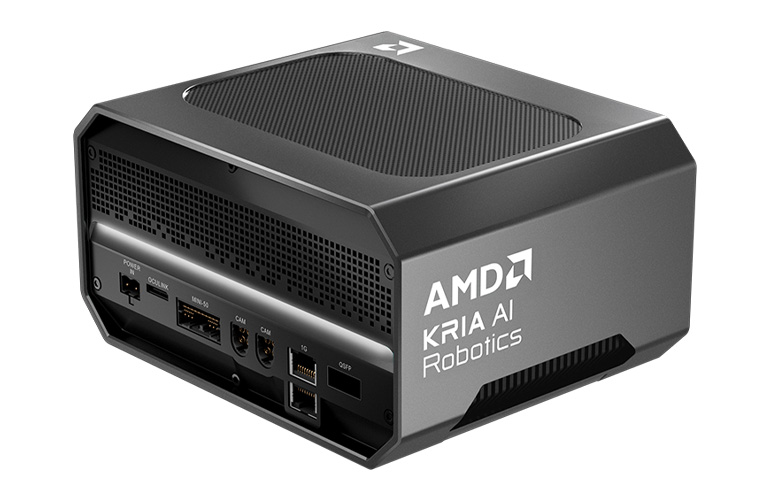
What happened
AMD unveiled the Ryzen AI Embedded X100 series processor and Kria AI system-on-module designed for robotics, along with open-source software and a partner network. The X100 features unified CPU–GPU–NPU memory architecture and promises deterministic real-time control via BIOS and Linux optimizations.
Why it matters
AMD claims the Kria delivers 3.4x better real-time performance over NVIDIA Thor T5000, has 1.6x spare compute capacity, and offers 2.3x more agentic AI capacity—giving robot builders an alternative to NVIDIA's dominant platform while introducing price pressure. The unified memory design reduces data copies, which is critical for perception, sensor fusion, and planning tasks in robots.
What to watch
The Kria AI robotics development kit is now available, featuring a robotics carrier card with GMSL, high-speed Ethernet, IMU, Wi-Fi/Bluetooth, and an integrated FPGA for real-time I/O. Early customers include Castec International (semiconductor fab AMR) and Foundation Robotics (humanoid robot developer), both migrating from Intel and NVIDIA to AMD's platform.
Summaries like this, in your inbox every morning.
AMD is positioning itself as a direct challenger to NVIDIA's dominance in physical AI and robotics by offering a complete stack—silicon, modules, software, and partnerships—rather than competing on chips alone. The unified memory architecture is a deliberate architectural choice: by eliminating the need to copy data between separate CPU and GPU memory pools, the X100 reduces latency and power consumption on the real-time control loops that robots depend on. This addresses a real friction point in current robotics systems, where data movement between heterogeneous compute devices adds both delay and complexity.
AMD's performance claims are specific and sector-focused. The comparison to NVIDIA Thor emphasizes FP32 floating-point performance for signal processing in aerospace and defense, where the X100 claims three times the compute. The broader system-level metrics—3.4x real-time performance, 1.6x spare capacity, 2.3x agentic AI capacity against Thor T5000—position AMD as offering not just a viable alternative but a quantitatively better fit for deterministic robotics workloads. By adopting the open COM-HPC standard instead of a proprietary form factor, AMD is explicitly countering a common vendor lock-in concern in robotics.
The presence of Foundation Robotics and Castec International as early customers signals that the platform is already attracting serious industrial users willing to migrate from Intel and NVIDIA. AMD's Robotics Partner Network, which includes Open Robotics and OpenCV alongside sensor and system integrator partners, suggests a deliberate effort to build ecosystem depth around the X100, not just announce it.
For example, today's edition would include:
AI-summarized, only the topics you pick — one digest a day via Email, Slack, or Discord.
Free · 30 seconds with Google · unsubscribe anytimeWhat is AIToday? →
Ask AI anything about this article. Q&As are published on this page for other readers too.
At the China International Optoelectronic Expo (CIOE), German laser and plasma generator maker Trumpf presente…

At a Deloitte Taiwan seminar in Taichung on September 15, industry and research leaders said Taiwan's next Phy…

According to the S&P 500's Shiller Price-to-Earnings (P/E) Ratio, this is the second-priciest stock market in…

Bloomberg reported that Crux AI, Blackstone and Alphabet's cloud venture, is set to receive $22 billion in chi…

Steve Yegge shut down Gas Town and admitted he never successfully built anything with it, despite spending tho…
Fed Chair Kevin Warsh told reporters that hyperscalers 'out in the market raising funding' are part of why the…