What happened
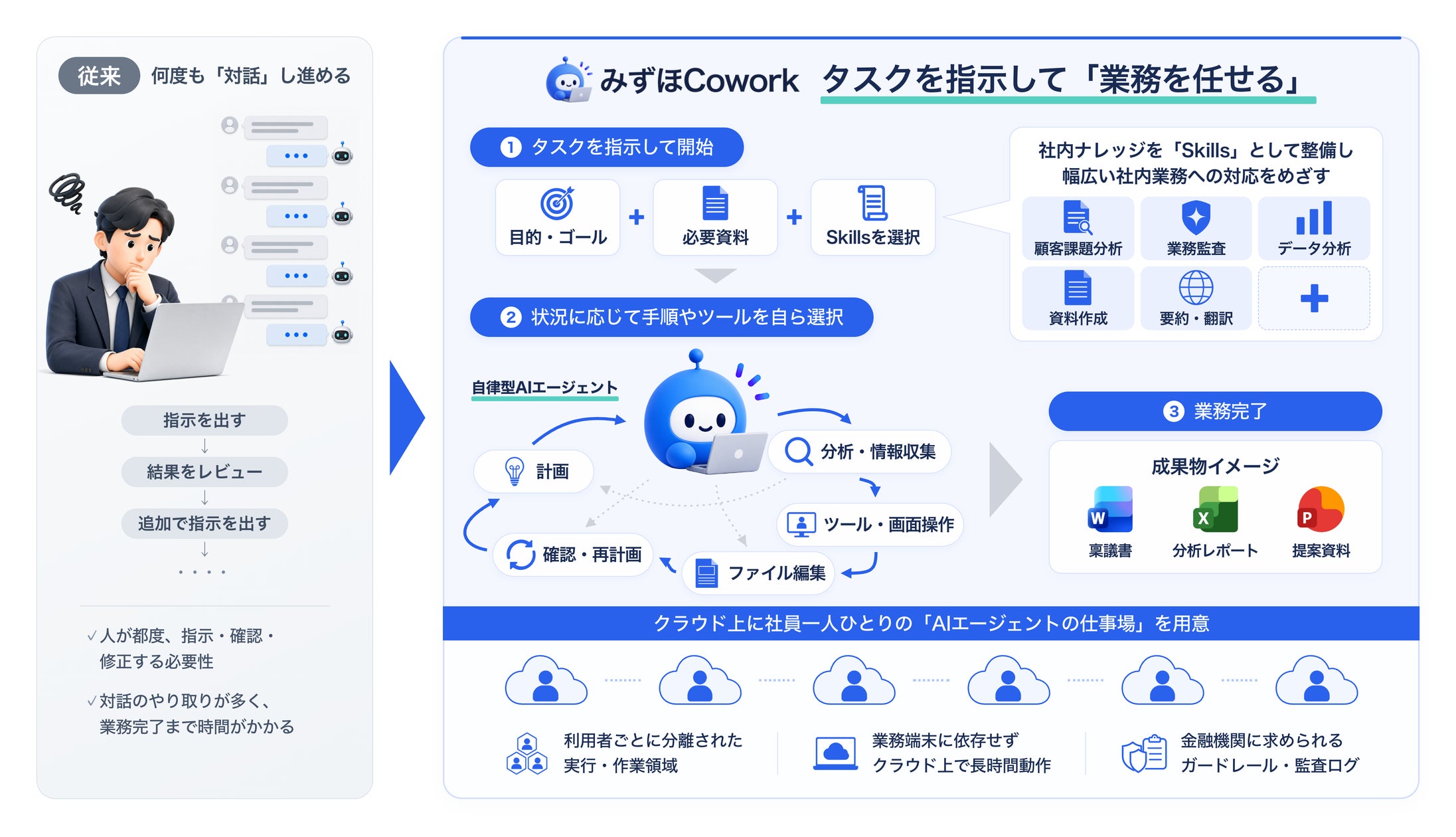
Mizuho Financial Group developed "Mizuho Cowork" using Anthropic's Claude Agent SDK on AWS, via AWS Professional Services support, and started PoC trials covering specialized tasks such as case document analysis, audit checks, and overseas report summarization and translation.
Why it matters
The platform builds on Mizuho's existing "Mizuho Wiz Base" common AI agent foundation and "agent factory" by adding a general-purpose agent that accepts "Skills" describing workflows and expertise, so it appears Mizuho can scale AI agent coverage across a wide range of operations more quickly.
What to watch
Mizuho is also considering having "Mizuho Cowork" operate browser screens for legacy internal systems without APIs, which would let the agent handle cross-system workflows without major system renovation. Whether the PoC confirms feasibility for tasks requiring specialized judgment will determine how broadly Mizuho expands the scope of adoptable operations.
WHO IT HITSInternal AI and digital talent teams at financial institutions, along with risk and compliance staff who must ensure agents operate within guardrails, are directly affected. Mizuho's approach of putting execution environments on managed AWS rather than employee PCs may also draw attention from IT architects at other regulated firms evaluating autonomous agent deployments.
Summaries like this, in your inbox every morning.
Mizuho's move builds on groundwork it had already laid: the company had established a company-wide common AI agent foundation called "Mizuho Wiz Base" and an "agent factory" to support rapid development of agents for individual operations. "Mizuho Cowork" is positioned as a further evolution of those efforts, separating Mizuho-specific business know-how from the underlying agent technology so that the latest AI models and agent technology can be continuously adopted while internal rules and expertise accumulate independently.
The architecture reflects a practical constraint Mizuho highlights in the body: autonomous agents typically run locally on user PCs, which creates challenges for enterprises needing to manage access scope and operation status. By hosting the execution environment and workspace on AWS, Mizuho avoids direct access to employees' business terminals and local data, and because agent operations do not depend on the employee's device, long-running processes can continue while the employee is not operating the terminal. The body also notes that the two-layer harness structure combines Claude Agent SDK's general agent layer with Mizuho's own layer for internal guardrails and Skills.
Looking ahead, the body suggests enterprise use of AI agents is shifting from humans instructing each step toward cloud-based agent work environments where AI autonomously assembles necessary procedures and advances long-running operations even when employees are away from their terminals. Whether Mizuho Cowork can deliver that vision is likely to hinge on the PoC results for tasks requiring specialized judgment and on how well browser operation of legacy systems works in practice, areas the body frames as ongoing verification and development rather than settled outcomes.
Pick your industry and the AI tools you use, and get news related to your work every day.
Free · 30 seconds with Google · unsubscribe anytimeWhat is AIToday? →
Ask AI anything about this article. The AI reads this article, earlier AIToday articles, and Wikipedia, and cites its sources. Q&As are published on this page for other readers too.
Ghost AI raised $11 million, led by Andreessen Horowitz with Abstract, Audacious Ventures, Nova and SV Angel…

Moonshot AI closed its final private round at about a $50 billion valuation and is aiming for a Hong Kong IPO…

OpenAI told Fortune it is piloting a 'mission interview' for candidates on certain teams, starting with market…

Reactor said it added Nvidia's venture capital arm and Sapphire Ventures to its cap table, bringing its total…
OpenAI will roll out invisible text watermarks to all ChatGPT and Codex plan users in the EU within weeks, and…
Reflection announced Beam, a 501B-parameter open-weight model with 23B active parameters, claiming parity with…