What happened
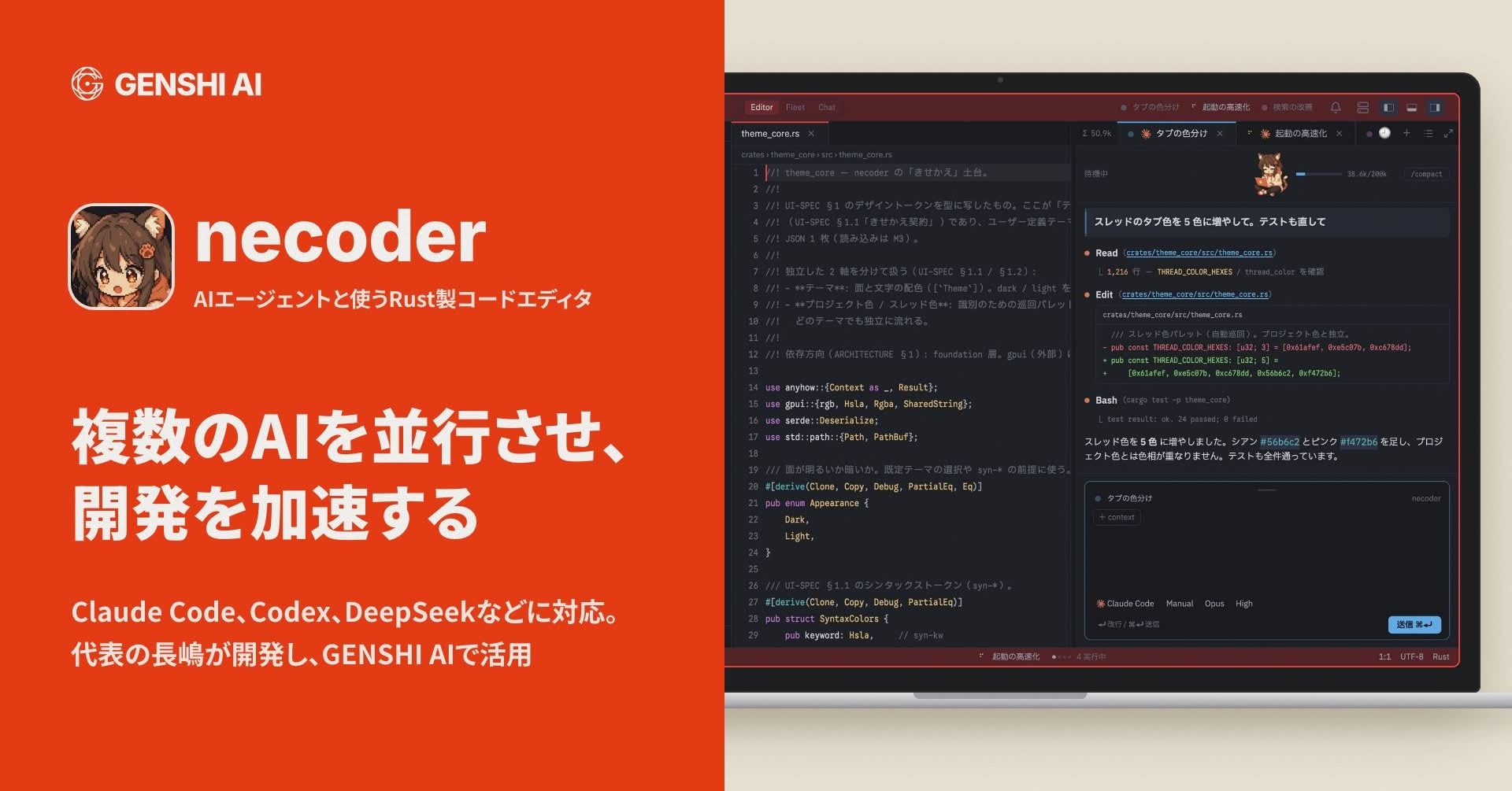
GENSHI AI said it adopted necoder in-house — a free, AGPL-3.0 Rust editor that Daichi Nagashima began building in July 2026, released in August, and moved to fully in September.
Why it matters
The tool is meant to let one engineer run several AI agents across projects in a single window without losing track of which agent is doing what, according to the company.
WHO IT HITSEngineers at small teams juggling multiple AI coding agents and repositories are the target users; the company says the editor's lower memory use helps on machines with limited RAM.
Summaries like this, every morning.
GENSHI AI is a small medical-AI startup developing four products in parallel, including the closed-network LLM platform MedLocal and the speech-recognition tool GENSHI Voice. Much of that work is done alongside AI agents, and CEO Daichi Nagashima was running ten or more projects at once, ending up with dozens of editor windows open. Existing editors made it hard to track which AI in which window was handling which task, and Electron-based editors consumed more memory with each new window, according to the company.
Nagashima began building necoder in July 2026, published the first version in August, and fully switched from Cursor in September. The editor is a native Rust application that renders its interface directly on the GPU and uses the GPUI framework from Zed Industries, avoiding Electron except for HTML previews. The company's own measurements put memory use about 96% lower than Cursor at idle and about 88% lower while Claude Code is running.
The editor's Fleet feature assigns each task its own git worktree so parallel AI agents do not collide, and a coordinating agent called Captain splits up work and merges it when done. Nagashima describes necoder as the tool he touches most each day, fixing inconveniences in code the same day and shipping 35 releases in roughly ten weeks after launch. GENSHI AI says it also uses Rust in part of GENSHI Voice, citing the language's ability to catch memory-related defects at compile time as a fit for reliability-sensitive medical systems.
Pick your industry and the AI tools you use, and get news related to your work every day.
Free · 30 seconds with Google · unsubscribe anytimeWhat is AIToday? →
Ask AI anything about this article. The AI reads this article, earlier AIToday articles, and Wikipedia, and cites its sources. Q&As are published on this page for other readers too.
Casap announced a $56 million Series B led by Base10 Partners, with Experian and Synchrony as strategic invest…

Kindai University will give 4,000 Paperpal licenses to full-time faculty and doctoral students at all campuses…

HIX AI's connector update on 11月4日 links Microsoft 365 (Outlook Mail, Outlook Calendar, OneDrive), Google Work…

Nicholas Carlini matched Stockfish 17, ported to a 200MHz Pentium Pro, against 1996's Crafty 11.13 on a modern…

Xin Liu and co-authors surveyed 291 open-weight LLM repositories and found 20 of 38 untied gated and hybrid ch…

Anthropic renamed Max 5x to Max and Max 20x to Ultra at unchanged $110 and $220 monthly prices, and dropped Ul…