What happened
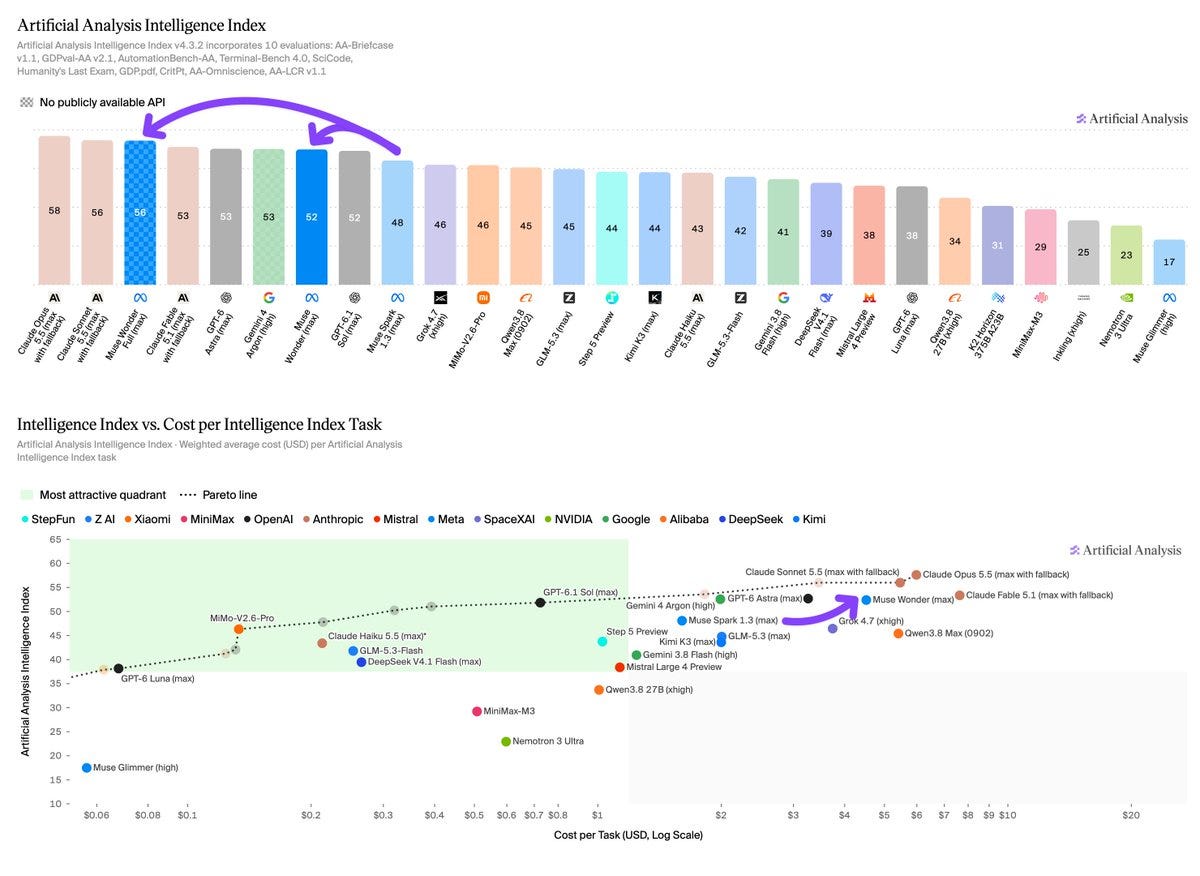
Meta Superintelligence Labs shipped Muse Wonder and Muse Wonder Full, scoring 52 and 56 on Artificial Analysis Intelligence Index v4.3 versus Muse Spark 1.3's 48, roughly 14 months after the lab was founded.
Why it matters
Wonder Full ranks top three on 6 of 10 evals and leads GDP.pdf and CritPt at 33%, positioning Meta's second-generation family near the frontier on agentic tasks.
WHO IT HITSMuse Code subscribers and developers using the Meta Model API gain a frontier-tier model for agentic coding and professional tasks. Enterprise IT teams weighing which AI model to standardize on now have another credible option at $4 input / $20 output per million tokens.
Summaries like this, in your inbox every morning.
Meta Superintelligence Labs was founded roughly 14 months before this launch, and Muse Spark was its first model family. Mark Zuckerberg described Wonder as "a much larger and more advanced class of models that brings us to the frontier." Alexander Wang said Meta continued scaling both pre-training and reinforcement learning since Spark shipped in April.
The launch split availability deliberately: Wonder is the faster frontier model available via the Meta Model API and Muse Code, while Wonder Full is the larger model restricted to Muse Code subscribers. Wonder will also power the Muse personal-agent product, with subscribers getting it first. On launch day, both models drained Muse Code quotas abnormally fast — a bug fixed the same day with a quota reset for all users.
Third-party evaluator Artificial Analysis put Wonder Full at 56 and Wonder at 52 on its Intelligence Index, against Spark 1.3's 48. The gap between Spark 1.3 and Wonder releases was only 6 weeks. Wonder Full improved on all ten index evals, with the largest gains in agentic categories: Terminal-Bench 4.0 went from 33% to 57%, and GDPval-AA v2.1 rose from 1681 to 1857 Elo. Wonder Full ranked top three on 6 of 10 evals, taking #1 on GDP.pdf and CritPt at 33%.
Meta presented plots showing performance on non-post-trained tasks versus post-trained tasks as evidence against benchmark overfitting, which some researchers singled out approvingly. Internally, Alexander Wang said research "starts with evals," with MSL building a Personal Superintelligence Index rather than chasing external benchmarks. Jason Wei summarized the effort as "scaling prevails," noting that much of Meta pivoted to support the model, including business development teams hiring human experts for data review.
The launch drew mixed reactions. Some early users ranked it alongside Opus 5.5 and praised its distinct prose style, while skeptics estimated Meta remains about 3–6 months behind OpenAI and Anthropic. The same day, Artificial Analysis launched a three.js scene benchmark where Claude and Astra models led — a pointed counter to Meta's emphasis on real-world agentic tasks over 3D rendering demos.
Pick your industry and the AI tools you use, and get news related to your work every day.
Free · 30 seconds with Google · unsubscribe anytimeWhat is AIToday? →
Ask AI anything about this article. The AI reads this article, earlier AIToday articles, and Wikipedia, and cites its sources. Q&As are published on this page for other readers too.
Anthropic says its defenses cut extracted reasoning tokens to between one-tenth and one-hundredth of prior lev…

Terence Tao gave a Caltech lecture on October 9, 2026, and posted it the next day, proposing "Math 2.0" — use…

KiteRa's survey of 1,206 employees at AI-agent-using companies found 13.4% had experienced policy or legal vio…

Anthropic's Frontier Red Team said models of 30B parameters or fewer could self-replicate on everyday IoT devi…
Meta announced Muse Wonder and Muse Wonder Full, its top AI models, with Muse Wonder available now via Meta Mo…

At TOKEN2049 in Singapore, Nansen CEO Alex Svanevik told Fortune that by 2028, trading with agents will be the…