What happened
Daifuku executive officer Yoshiyuki Aiba said at a media tour tied to the International Logistics Exhibition 2026 in Tokyo that the company is developing a humanoid robot and aims to have it do real-world work by 2030.
Why it matters
Its warehouse partnership with Intelest Systems already automates about 85% of processes such as picking and sorting, but the remaining 15% of tasks are sticking points that generative AI-driven material handling is meant to close.
What to watch
Aiba said Daifuku hopes to avoid wearing out many expensive motors and to cut power consumption by designing a robot that runs on one maintenance check per year.
WHO IT HITSWarehouse and logistics operators that run Daifuku's materials-handling systems stand to gain from further automation of the picking and sorting work that humans still handle, likely reducing reliance on warehouse floor staff if the 2030 target is met.
Summaries like this, in your inbox every morning.
Daifuku has built its business on automated material handling for factories and distribution centers, and its partnership with Intelest Systems covers roughly 85% of warehouse processes such as receiving, storage, picking, sorting, and shipping. The hard remainder is picking, the step where people are still most involved, and the company has been working on the problem with AI-guided picking using an X-Y gantry robot combined with AI, though dealing with irregular or soft goods remains difficult.
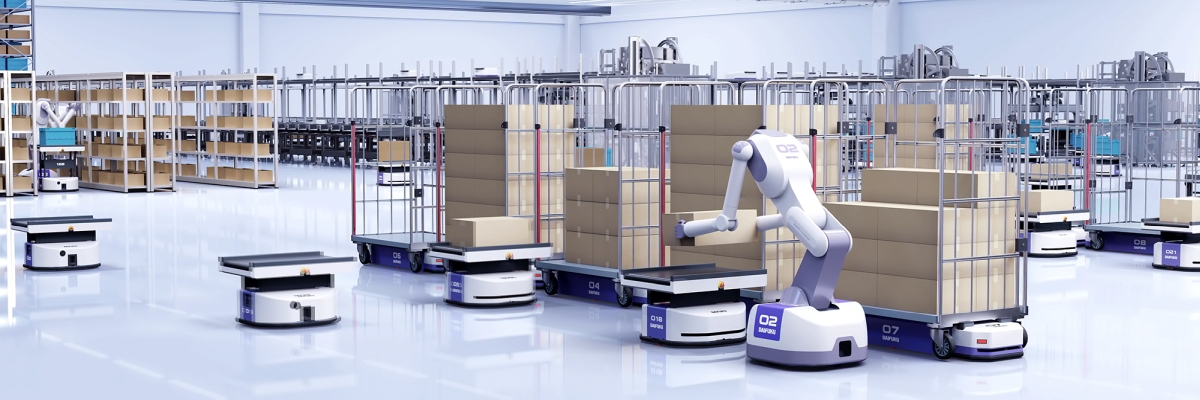
At the International Logistics Exhibition 2026, Daifuku demonstrated warehouse solutions that pair its Fly Silent robot with mid-size SOTR-M and small SOTR-S AMRs (autonomous mobile robots) in a ground-level case-picking setup, and combined a four-way pallet shuttle, a pallet-based fork lift SOTR-F, and a large SOTR-L AMR for a pallet-based demonstration. Against that backdrop, the humanoid robot is presented as the piece meant to finish the job.
Aiba's remarks point to a development strategy anchored in cost and durability rather than capability alone: fewer motors, less wear, and one maintenance cycle per year. Whether the 2030 target is met will likely hinge on whether that approach holds up in real warehouse conditions, and on how humanoid makers respond to the requirements Daifuku says it has already communicated to them.
For example, today's edition would include:
AI-summarized, only the topics you pick: one digest a day via Email, LINE, or Slack.
Free · 30 seconds with Google · unsubscribe anytimeWhat is AIToday? →
Ask AI anything about this article. The AI reads this article, earlier AIToday articles, and Wikipedia, and cites its sources. Q&As are published on this page for other readers too.
Kalkine Media reports that Home Depot (NYSE:HD) is introducing an AI assistant for its retail operations

Daniel Roher's Netflix documentary 'The AI Doc: Or How I Became an Apocaloptimist' presents both AI safety exp…

NVIDIA announced the NVIDIA Open Agent Safety Platform, an open software platform and reference design to secu…

AMD said Monday it agreed to acquire World Labs, Fei-Fei Li's San Francisco AI lab, for about $8.2 billion in…

Bank of America announced Payments Insights, a new CashPro capability that analyzes payment efficiency, cross-…

NVIDIA announced its NVIDIA Open Agent Safety Platform, combining OpenShell open-source software for secure ag…