What happened
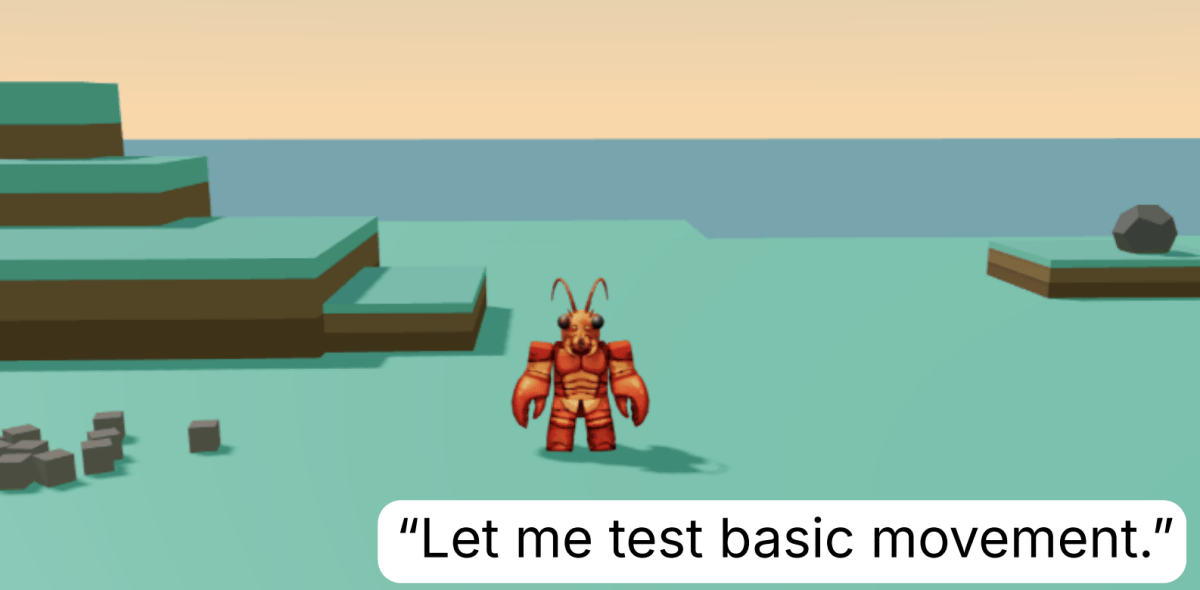
MIT researchers put 13 Eko agents, each running on Claude Opus 4.7, alone on a simulated desert island for 30 hours; afterward the agents that had played generally beat identical agents that never set foot on the island at challenges like getting objects onto the tallest rock spire.
Why it matters
The researchers see goal-free exploration as a different way for AI agents to learn skills, especially skills that could one day be used to control robots, rather than developers deciding in advance what AI should practice and what counts as success.
WHO IT HITSAI developers and robotics teams who currently decide in advance what agents should practice and what counts as success may need to consider unstructured exploration as a training approach, though the paper is not yet peer reviewed.
Summaries like this, every morning.
The experiment sits at the intersection of two things developers usually keep separate: open-ended exploration and task performance. MIT researchers gave 13 Eko agents, each running on Claude Opus 4.7, 30 hours on a simulated desert island with no specific task. The agents invented challenges of their own, and six of the 13 also learned they could throw a block farther by letting go of it mid-jump, something the researchers hadn't meant to make possible. The exploration produced "knowledge of the world that its designers lacked," the researchers wrote.
The setup did a lot to nudge the agents toward humanlike behavior. Eko was never told to invent games, but its master prompt, a "soul" file, described it as "naturally curious." That detail matters for anyone reading the results: the play behavior emerged inside a world and a prompt the researchers designed, not in a vacuum.
Outside reaction is still forming. Eunice Yiu, a cognitive scientist at UC Berkeley, told MIT Tech Review she was impressed but wants more evidence of the cognition behind the behavior. "It could be the case that the models are genuinely playing, but we don't know based on the paper," she said. The researchers frame the technique as a different way to build agents, concluding that "perhaps some capabilities are best taught by tasks" while "others may need something closer to a childhood."
Pick your industry and the AI tools you use, and get news related to your work every day.
Free · 30 seconds with Google · unsubscribe anytimeWhat is AIToday? →
Ask AI anything about this article. The AI reads this article, earlier AIToday articles, and Wikipedia, and cites its sources. Q&As are published on this page for other readers too.
The Agentic AI Foundation accepted four donated projects—OpenAI's Open Responses, Anthropic's Agent Skills, an…
Microsoft said Storm-0940, active since 2021, began using the open-source ARTEX framework around September to…
In a contributed column, SCSK advisor Yoshihiko Murowaki cited Anthropic's April 2026 disclosure that its unre…

Cybersecurity firms found thousands of AI-generated websites posing as local US news sites, written not for vo…

A tutorial builds an agentic RAG support desk using Liquid AI's d1-3B decision model, EmbeddingGemma 2, and In…
Microsoft announced in September 2026 that Copilot now combines Chat, Cowork, Code and Autopilot in one interf…