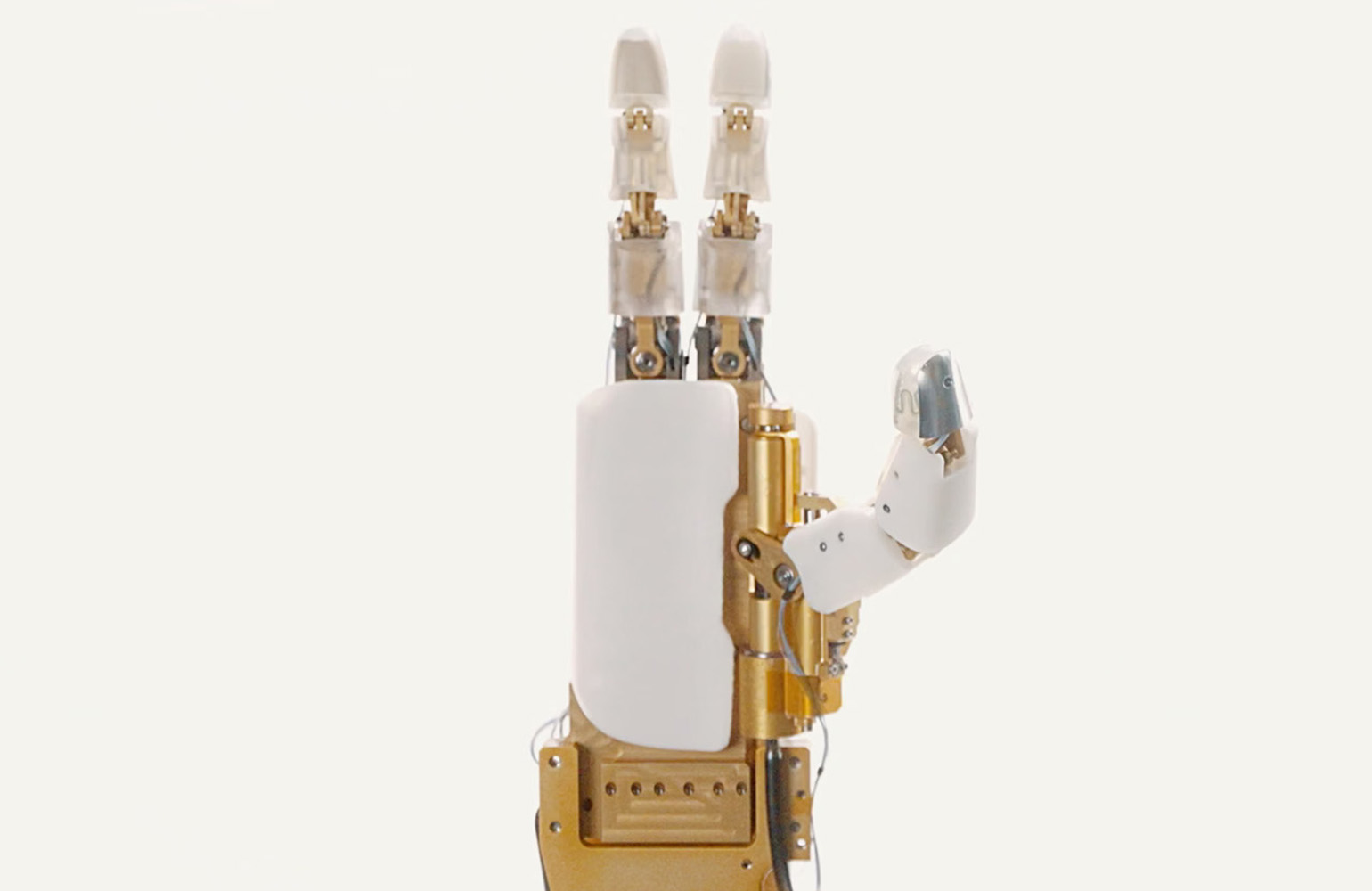
Tacta Systems has launched the TactaBot, a robotic hand system designed for high-skilled manufacturing work. The robot features a five-fingered hand with tactile sensors smaller than a grain of sand, paired with a data-capture glove that records touch, motion, video, and temperature from skilled workers to train the AI.
This addresses a critical gap in robotics: while computer vision has advanced, robotic hands have lacked the sensory feedback and dexterity needed for precision manufacturing tasks.
The company plans to begin shipping systems in early 2027.
What happened
Tacta Systems launched the TactaBot, a robotic system combining a five-finger Tacta Hand (with 15 degrees of freedom), a Skill Capture glove equipped with 256 tactile sensors per fingertip, and a Dexterous Intelligence AI model. Each fingertip can lift up to 25 newtons of force (about 2.5 kg), and the hand can operate for up to 30 million cycles using Tacta's proprietary Fluidic Tendon actuation technology.
Why it matters
High-skilled manufacturing work—where human touch, precision, and sensory feedback are critical—has faced severe workforce shortages. Tacta's approach addresses a gap in robotics by equipping machines with tactile sensing and dexterity that rivals human hands; the company captures real-world training data directly from workers using the glove, significantly reducing the time needed to teach robots new skills compared to vision-only or conventional robotic systems.
What to watch
Tacta expects to ship its first TactaBots in early 2027. The company is initially targeting electronics manufacturing and sees opportunity in U.S. reshoring; longer-term applications mentioned include nursing homes, hospitals, and food preparation.
Tacta Systems last week unveiled the TactaBot, a robotic system designed to handle high-skilled manufacturing work that has traditionally required human workers. The system consists of three integrated components: the Tacta Hand, a Skill Capture data-collection system, and a Dexterous Intelligence AI model. Vikram Pavate, co-founder and CEO, explained to The Robot Report that the robotics industry has succeeded in moving objects with vision-only and conventional robots, but "the holy grail is to be able to augment, complement, and expand the potential to use robots to do high value work." He noted that some of the world's biggest workforce shortages center on skilled labor in manufacturing environments.
The Tacta Hand is a five-fingered, human-sized gripper with 15 degrees of freedom (three per finger). Each fingertip can lift up to 25 newtons of force—approximately 2.5 kg (5.5 lb.)—and the entire hand is built around Tacta's proprietary Fluidic Tendon actuation technology. Rather than using motors or traditional cables, this system moves fluids through cables to push pistons and move the fingers. According to Pavate, this approach allows for very thin fingers, generates no heat near the hand, and achieves "incredible stability and precision" that motor-driven hands cannot match. The hand is also more reliable than cable-driven alternatives; if one cable fails in a traditional gripper, the entire hand breaks down, whereas Tacta's hand can operate for up to 30 million cycles. The fingertip sensors are designed as replaceable consumables, acknowledging that while the mechanical components have a long cycle life, the sensors will eventually wear.
The core of Tacta's capability lies in its proprietary tactile sensors, which are smaller than a grain of sand and can recognize the full dynamic range of human touch, from 250 pascals to 700,000 pascals. The sensors also measure temperature with a precision of 0.1 degrees centigrade. These are not MEMS-based sensors; each has its own analog-to-digital conversion and operates at a 1 mm pitch. The Tacta Glove, used for data capture, features 256 of these sensors on each fingertip. Pavate acknowledged that today's AI models for robotics are severely limited by a lack of relevant real-world data: "There's no Shakespeare and the web and Reddit and The New York Times to train these models in the physical world, especially for high value work." The Tacta Glove captures force, motion, video, and temperature data as workers perform complex tasks on the factory floor, with all data streamed wirelessly to a local host device. Workers can deploy the glove immediately without training and wear it naturally while completing their work; every hour of work further compounds the robot's training dataset.
Tacta's approach uses an off-the-shelf, pre-trained AI model that is then refined using the tactile and motion-capture data collected by the glove for specific tasks. When deployed at a customer site, Tacta fine-tunes the model using its gloves on the customer's actual operations, significantly reducing the training time needed to learn new skills. Pavate noted that in the long term, he envisions this technology in nursing homes, hospitals, food preparation, and even scenarios like a world-renowned sushi chef or pianist wearing the gloves to capture expert technique. For now, however, Tacta is focusing on manufacturing, an environment where the company's founders spent many decades, particularly in electronics. With reshoring a priority for U.S. industry and robotics suppliers, Tacta sees strong opportunity in electronics manufacturing. The company expects to ship its first TactaBots in early 2027.
Tacta Systems identified a fundamental limitation in robotics three years ago: while computer vision and AI have advanced, robotic hands lack the sensory feedback and dexterity to perform high-value skilled work. This gap has left significant workforce shortages, particularly in manufacturing environments where human touch, precision, and real-time tactile feedback are essential. The company's solution integrates three components—a mechanically dexterous five-fingered hand, proprietary tactile sensors, and a data-capture system—to close what Pavate calls the "physical AI data gap." Unlike language-based AI models trained on vast digital corpora, robotics AI has historically suffered from a scarcity of relevant real-world training data; Tacta addresses this by capturing worker movements and tactile data directly from the factory floor, then using that data to train its models on site. The timing aligns with industry interest: reshoring and automation of electronics manufacturing are top priorities for U.S. industry, and Tacta's focus on that sector reflects both market opportunity and the founders' decades of experience in electronics.
AI-summarized, only the topics you pick — one digest a day via Email, Slack, or Discord.
Free · takes 30 seconds · unsubscribe anytime
Ask AI anything about this article. Q&As are published on this page for other readers too.
FlybyOps, a Finland-based company, has launched an enterprise platform designed to help commercial drone opera…

Google and Cleveland Clinic announced a partnership to develop AI-powered robotic systems designed to improve…

Archer Aviation is acquiring Boeing subsidiaries Wisk Aero, SkyGrid, and Insitu, expected to close by end of 2…

Archer Aviation announced a deal with Boeing to develop physical AI applications for the aerospace and defense…

Archer Aviation announced it will acquire three Boeing subsidiaries—Wisk Aero (eVTOL aircraft), Insitu (unmann…

An autonomous robot called temi, paired with a no-code programming app called Buddiotte and integrated support…

The AI news that matters, in one minute each morning.
Sign up free