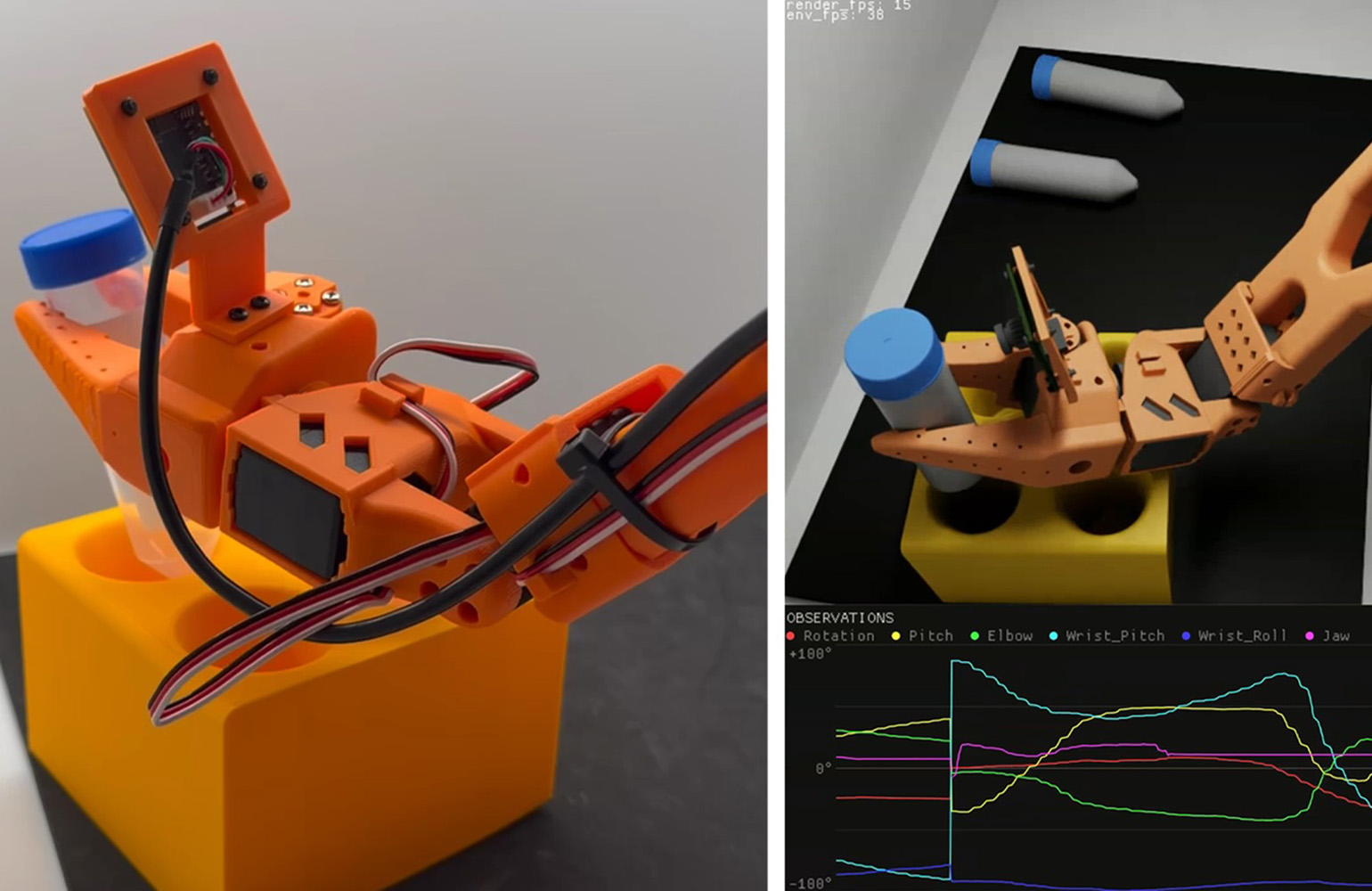
What happened
NVIDIA and Hugging Face have integrated NVIDIA Isaac GR00T 1.7 (an open reasoning vision-language-action model for humanoid robots) and the NVIDIA Isaac Teleop framework into LeRobot, Hugging Face's open-source robotics library. NVIDIA Cosmos 3, a frontier world model for physical AI, is planned to arrive on the platform soon.
Why it matters
These integrations aim to lower barriers to robot development by giving developers a shared, standardized path for training, evaluating, and deploying robot models—reducing reliance on costly, fragmented resources. The partnership connects NVIDIA's 3 million robotics developers with Hugging Face's 16 million AI builders, potentially broadening access to frontier physical AI tools across the open robotics community.
What to watch
LeRobot's open-source physical AI dataset has already been downloaded more than 15 million times and includes more than 350,000 real and simulated trajectories and 57 million grasps. Developers can now also access NVIDIA Isaac Sim, Isaac Lab, and Isaac Lab-Arena simulation frameworks, plus NVIDIA Jetson Thor integration with the Reachy 2 open-source humanoid robot.
Summaries like this, in your inbox every morning.
Open-source AI development has shown that sharing models, data, and tools accelerates innovation. Robotics faces a similar opportunity but has historically been gated by costly, fragmented resources—expensive datasets, robot foundation models, simulation tools, and compute infrastructure that smaller teams cannot easily access. By bringing NVIDIA's robotics AI capabilities directly into LeRobot, both companies are attempting to lower that barrier and create a common, standardized development loop for the broader robotics community.
The partnership is built on existing momentum: LeRobot's physical AI dataset has already been downloaded more than 15 million times, and simulation frameworks from NVIDIA Isaac Sim and Isaac Lab are already integrated. Adding Isaac GR00T 1.7—a commercially viable, open foundation model for humanoid robots—and Isaac Teleop (for standardized data collection) extends that foundation. The planned arrival of Cosmos 3, a frontier world model, could further enable developers to generate synthetic training data and test policies when real-world data is scarce or expensive.
For developers, the significance lies in consolidation: rather than patching together separate tools and platforms, roboticists can now use a single workflow in LeRobot to collect data, train models, run simulations, and deploy to physical robots. NVIDIA's stated connection of its 3 million robotics developers to Hugging Face's 16 million AI builders suggests the companies intend this platform to reach beyond traditional robotics specialists into the broader AI engineering community.
Pick your industry and the AI tools you use, and get news related to your work every day.
Free · 30 seconds with Google · unsubscribe anytimeWhat is AIToday? →
Ask AI anything about this article. The AI reads this article, earlier AIToday articles, and Wikipedia, and cites its sources. Q&As are published on this page for other readers too.
Vinci4D provides chip-design simulation software that trains on physics equations instead of customer data, an…

SEMI President and CEO Ajit Manocha told DIGITIMES that the semiconductor industry reached the US$1 trillion r…
CoreWeave fell more than 25% this week, its debt yield briefly rose above 16% on Thursday, and SK Hynix droppe…

Nvidia's AI Enterprise lists at $4,500 per GPU annually, and paid subscriptions add supported software, securi…
China's commerce and science ministries released a draft update adding 23 key AI technologies to its export co…

Anthropic told investors this week that it is making 85% gross margins, a figure the columnist calls a cash co…