What happened
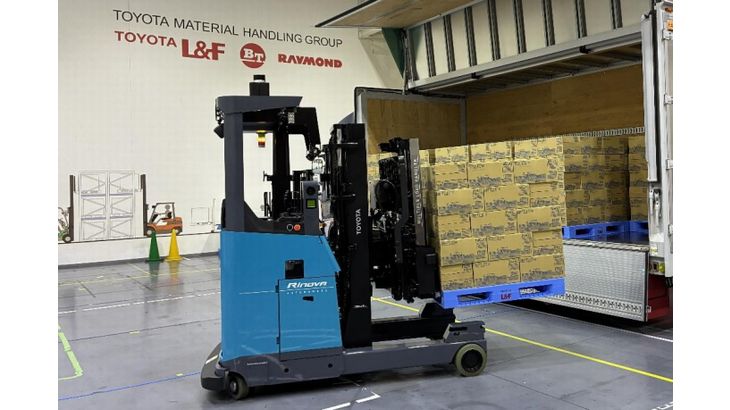
Suntory Logistics and Toyota Industries announced on September 1 that they will begin a demonstration test in November this year at the Suntory Logistics Urawa-Misono Distribution Center in Saitama City, using Toyota Industries' automated driving forklift "Rinova Autonomous" equipped with a multi-load handler that can switch between two and four forks.
Why it matters
This is described as Japan's first automated driving forklift for truck loading with a multi-load handler using 3D-SLAM guidance. The test aims to verify precision, stability, and practical responsiveness when transporting different numbers of pallets, potentially automating the entire forklift workflow from unloading to loading—a step toward addressing chronic labor shortages and aging in the logistics industry.
What to watch
The companies aim for actual operation from September 2028 onward, with the operation location yet to be decided. The demonstration will assess whether switching fork counts on a single forklift can meet the need for flexible truck loading automation.
Summaries like this, every morning.
The announcement builds on an existing partnership between Suntory Logistics and Toyota Industries. Since 2021, the two companies have automated the warehousing of incoming products at the Urawa-Misono center. Loading and unloading trucks, however, has remained manual. This new test targets that gap.
The need for a switchable-fork design stems from industry practice. Beverage companies widely use four-fork forklifts to move two pallets at once for efficiency. Yet conditions at loading docks or factory entrances sometimes require moving just one pallet with two forks. Toyota Industries, which has expanded its automated product lineup since 1989, developed the multi-load handler to address this.
If the forklift proves reliable, the companies expect to automate the entire sequence of pallet work—from unloading trucks to storage and later loading. This could significantly ease labor shortages and the aging workforce in logistics, though the companies note this is an expected benefit rather than a guaranteed outcome.
Pick your industry and the AI tools you use, and get news related to your work every day.
Free · 30 seconds with Google · unsubscribe anytimeWhat is AIToday? →
Ask AI anything about this article. The AI reads this article, earlier AIToday articles, and Wikipedia, and cites its sources. Q&As are published on this page for other readers too.
Warp Sciences, an AI-and-robot chemistry CRO led by ex-OpenAI product chief Kevin Weil, launched on the 22nd w…
Tesla cut its 2026 capex guidance by $5 billion to $20 billion, just three months after lifting it by $5 billi…
inDrive, Pony.ai and Nvidia signed a memorandum of understanding to test Pony.ai's Gen-7 robotaxis in Astana…
A Tesla car hit and killed a man on a highway while in automated driving mode
MIT researchers put 13 Eko agents, each running on Claude Opus 4.7, alone on a simulated desert island for 30…
P&G CFO Andre Schulten said the company is proactively preparing for AI agents that place orders and reshape s…