What happened
Dyna Robotics released Dyna-2.1, a physical robot agent built around its Dyna-2 world-action model, which it says achieves reliable super long-horizon whole-body autonomy for ultra-long real-world workflows.
Why it matters
If hour-long autonomy holds up, robots can move past short scripted demos toward continuous real-world work, which is what Dyna says separates production deployments from pilots.
Summaries like this, in your inbox every morning.
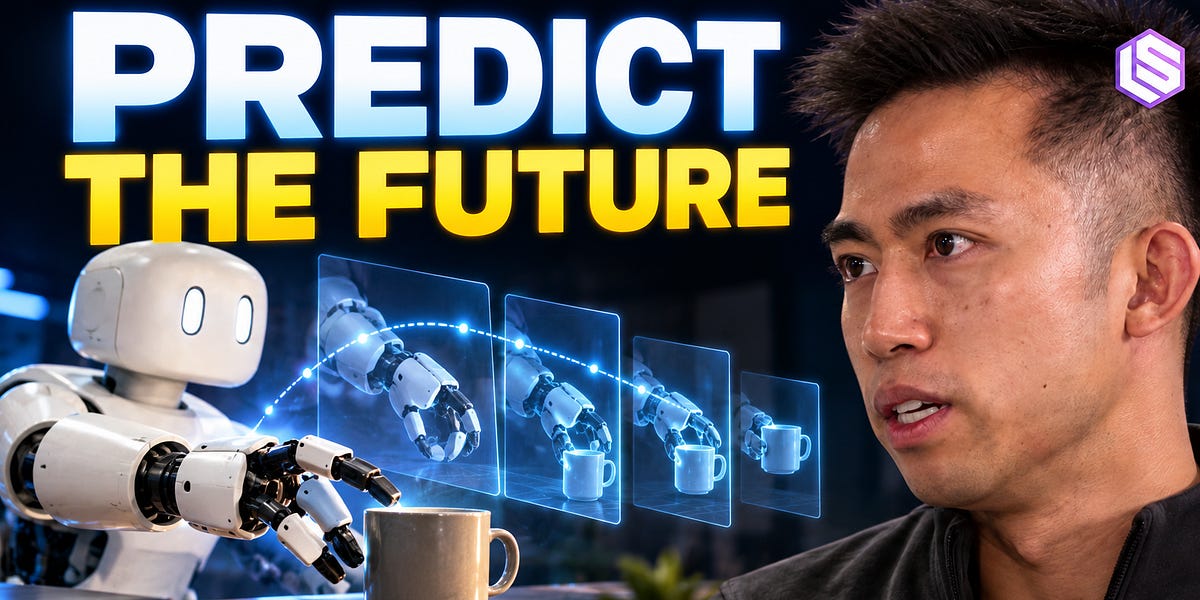
Dyna Robotics followed its Dyna-2 world-action model, announced last month, with Dyna-2.1, a physical robot agent it says achieves reliable super long-horizon whole-body autonomy. The company pairs that agentic system with new semi-humanoid hardware rather than off-the-shelf humanoids; co-founder and chief scientist Jason Ma has explained that choice as a hardware decision, and the episode touches on why Dyna builds its own hardware at all.
The underlying model is the other half of the story. Dyna-2 is a diffusion-transformer world-action model trained on more than one million hours of human video — the company says it found new scaling laws on human data across four orders of magnitude. In the episode, Ma describes the robotics data problem plainly: unlike language models, robotics has no internet, so a single company cannot collect enough data on its own. The recipe he outlines combines large egocentric human video to give the model a broad prior with a smaller amount of robot-collected data for low-level dexterity, which is why Dyna invited data vendors to reach out through an email address listed in its Dyna-2 blog post.
Pick your industry and the AI tools you use, and get news related to your work every day.
Free · 30 seconds with Google · unsubscribe anytimeWhat is AIToday? →
Ask AI anything about this article. The AI reads this article, earlier AIToday articles, and Wikipedia, and cites its sources. Q&As are published on this page for other readers too.
SoftBank CEO Masayoshi Son spoke about superintelligence, AI investing, and the future of robotics, in a discu…

Scan Computers partnered with Sheffield-based OLO Robotics to combine Scan's robotics hardware with OLO's brow…
Ubitium raised $14 million in seed funding led by Ibex Investors, bringing total seed funding to $18 million s…
Laplace Intelligence, co-founded by CEO Howie Sun and chief scientist Henry Liu, is building AI agents that au…

Flox Intelligence, spun out of KTH in 2020, is opening a $10 million Series A after raising about $5 million i…
Munich-based Spranic is building a spatial memory layer that records physical spaces and how they change, and…