What happened
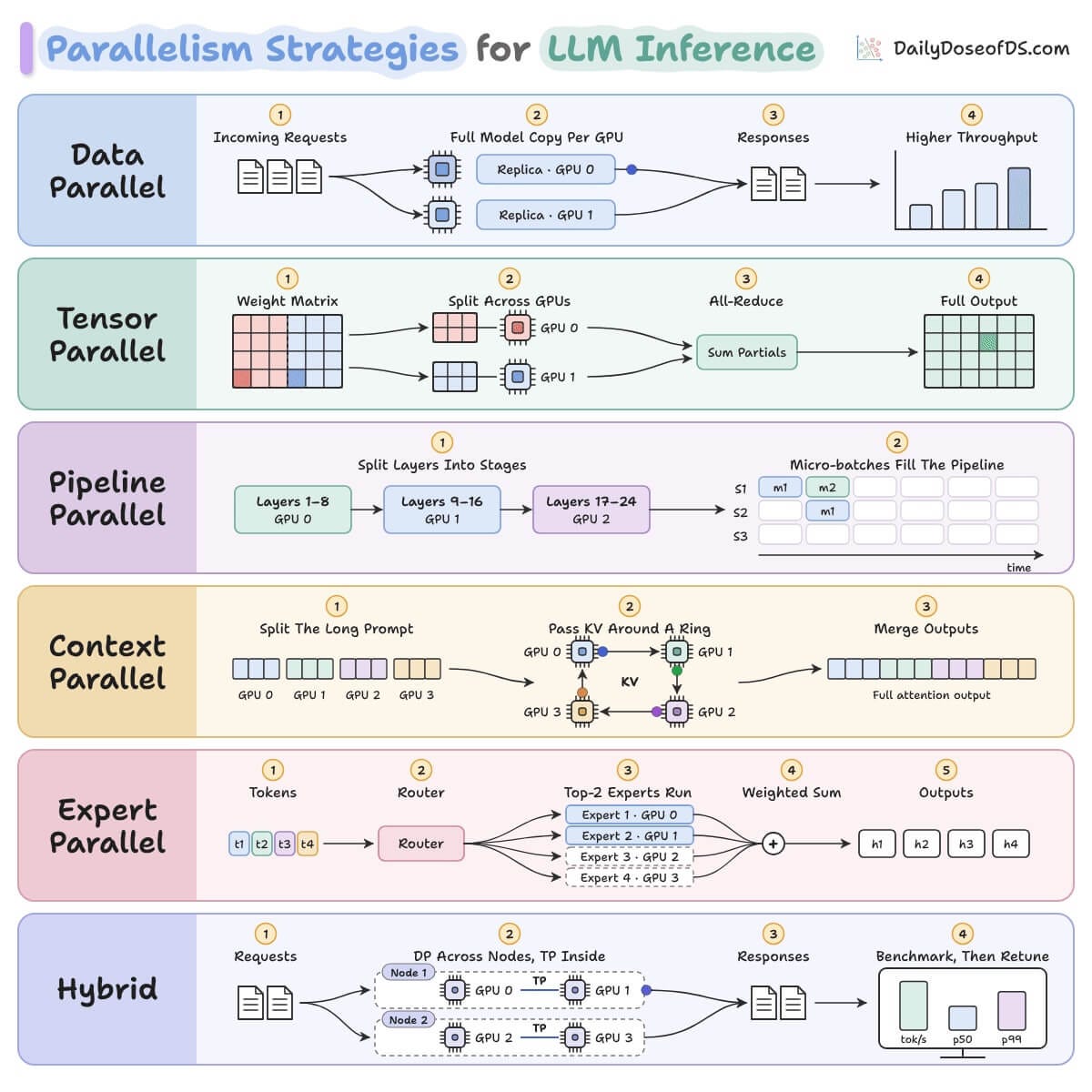
A newsletter laid out six common strategies for parallelizing LLM inference — data, tensor, pipeline, context, expert and hybrid — and said each removes a local memory or compute limit but adds communication overhead.
Why it matters
The piece frames parallelism as a trade-off, not a free speedup, so the choice of strategy should follow a measured bottleneck rather than a preference.
Summaries like this, in your inbox every morning.
The newsletter sets out the constraint that drives all of this: running a model across four GPUs does not merge their memory into one shared pool, so data stored on another GPU must cross the interconnect before a layer can use it. That is why parallelism is presented as a trade-off — local memory or compute limits go away, but communication overhead arrives in their place.
The piece then matches each strategy to the limit it removes. Tensor parallelism splits matrix operations inside each transformer layer, cutting weight memory per GPU while forcing the GPUs to combine partial results throughout the layer stack. Pipeline parallelism assigns layer groups to different GPUs, moving activations between stages and leaving some stages idle when micro-batching is insufficient. Context parallelism splits sequence positions two ways: prefill context parallelism divides a long input across GPUs to target lower TTFT, while decode context parallelism divides the stored KV history to increase cache capacity, with every decoder layer merging partial attention results. Expert parallelism distributes MoE experts across GPUs, adding network cost and idle time from token routing and uneven expert load. Hybrid parallelism combines several of these in one deployment, for instance tensor parallelism within a node, pipeline parallelism across nodes, and data parallelism across model replicas, matching each communication pattern to the available links at the cost of more coordination paths.
The practical advice is to treat each method as a fix for a measured bottleneck: tensor or pipeline parallelism when weights do not fit, the corresponding context parallelism when long-prompt prefill or KV-cache capacity is the limit, expert parallelism for MoE models that need expert weights placed, and data-parallel replicas when one replica meets its latency target but requests still queue. Tensor parallelism belongs on the fastest links, and after every change the relevant metrics should be measured again before another method is added.
Pick your industry and the AI tools you use, and get news related to your work every day.
Free · 30 seconds with Google · unsubscribe anytimeWhat is AIToday? →
Ask AI anything about this article. The AI reads this article, earlier AIToday articles, and Wikipedia, and cites its sources. Q&As are published on this page for other readers too.
Dell's Helen O'Sullivan said Bay Area customers are exhausting token budgets allotted for months within a matt…

Meta released Muse Wonder and Muse Wonder Full, agent models for long, multistep tasks such as insurance claim…

Google Cloud announced Gemini Agent on October 9, a multi-agent tool that runs in the cloud and isn't locked t…
Meta unveiled Muse Wonder and the higher-tier Muse Wonder Full on October 12, calling them its largest and mos…
A developer entered the 5th Agentic AI Hackathon with Google Cloud with "Vulnerability Busters," which scans a…

The developer of HACH, a resident AI agent for Slack, Teams and Chatwork, published a design guide arguing lon…

