What happened
Michael Burry wrote in a Substack chat that Trump's team knows the AI buildout is 'the only thing keeping this economy going,' adding 'They cannot afford to let it fall.' Recent reports show him boosting bearish bets on Micron, Nebius, Palantir and semiconductor stocks.
Why it matters
Burry is flagging a split in his own thesis — he sees the buildout as propping up the economy while still questioning whether the investors funding it will earn acceptable returns.
What to watch
Whether Burry's bearish call is vindicated hinges on AI capital spending producing real returns — a test that plays out in utilization, financing costs and free cash flow at Nvidia, Oracle, CoreWeave and other AI-linked stocks.
WHO IT HITSPortfolio managers and retail investors holding AI-linked stocks such as Nvidia, Oracle and CoreWeave face a sharper debate over whether the capital spending behind the boom will translate into returns, while macro-focused investors weigh how much of U.S. growth now leans on that spending.
Summaries like this, in your inbox every morning.
Michael Burry's warning lands at a moment when AI infrastructure spending has become large enough to show up in the headline economic numbers. J.P. Morgan Asset Management estimates that AI-related investment contributed about 0.47 percentage points to the 2.1% pace of U.S. real GDP growth over the past year — roughly one-fifth of total growth after adjusting for imported hardware — and hyperscalers are expected to spend nearly $800 billion on capital expenditures this year. That is the backdrop for Burry's claim that the buildout is the only thing keeping the economy going.
Burry's position is unusual because it does not simply dismiss the boom. He argues that the spending is supporting economic growth while simultaneously questioning whether the investors funding it will earn acceptable returns. Recent reports show him increasing bearish exposure to Micron, Nebius, Palantir and semiconductor stocks. The AI trade is also intersecting with Trump's disclosed investment portfolio: his accounts reported 1,156 securities transactions in July worth an estimated $79 million to $270 million, including Microsoft and Amazon sales valued between $5 million and $25 million each, followed days later by smaller purchases of both stocks.
The stakes, as the article frames them, hinge on whether the capital flowing into GPUs and data centers ultimately produces durable returns. For Nvidia, Oracle, CoreWeave and other AI-linked stocks, the test is likely to show up in utilization, financing costs and free cash flow. Burry's thesis may be proven or undercut by those numbers — not by the size of the spending itself.
For example, today's edition would include:
AI-summarized, only the topics you pick: one digest a day via Email, LINE, or Slack.
Free · 30 seconds with Google · unsubscribe anytimeWhat is AIToday? →
Ask AI anything about this article. The AI reads this article, earlier AIToday articles, and Wikipedia, and cites its sources. Q&As are published on this page for other readers too.
Anthropic launched Claude Sonnet 5.5, a mid-tier model for everyday tasks, priced at $2 per million input toke…

NEAR, the token of the NEAR Protocol, has more than doubled in value over the past two weeks, helped by surgin…
GPU rental prices doubled in six months, from $4.40 to $8.08 per GPU-hour, even as Claude Opus 5.5 costs 40% l…
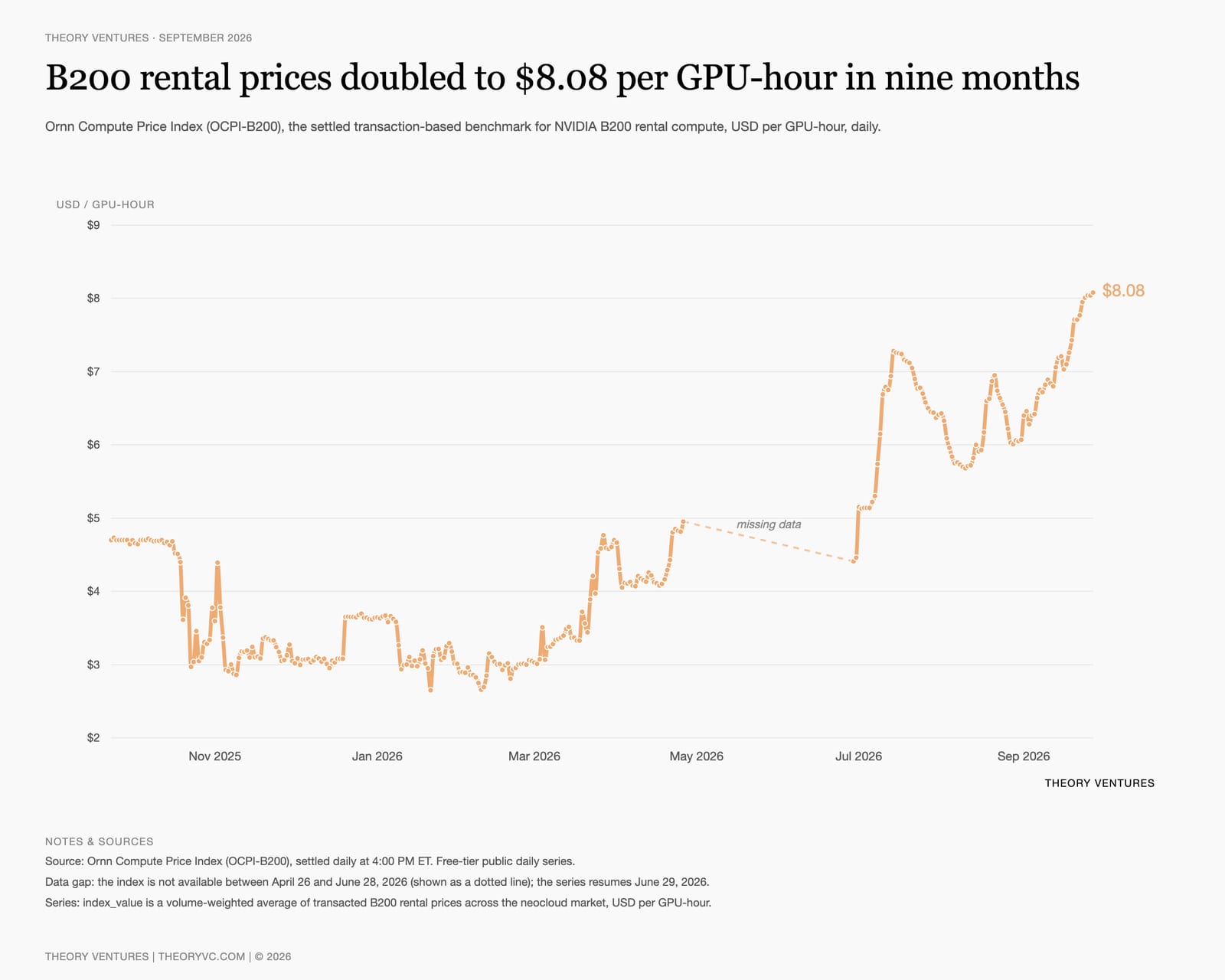
Anthropic released Claude Sonnet 5.5, which it says runs output more than 30 percent faster and costs up to 30…

The University of Florida found only 10-15% of its data was semantically defined; using NaviGator AI and Snowf…

In a Nikkei Money discussion, private investor Okeido said he sets his investing goal years out and basically…