What happened
Google released Gemini 3.8 Live and 3.8 Live Extended Thinking, two speech-to-speech models similar in shape to OpenAI's GPT-Live family.
Why it matters
Google now offers two tiers of live speech models, one standard and one for extended thinking, matching the shape of OpenAI's GPT-Live lineup.
What to watch
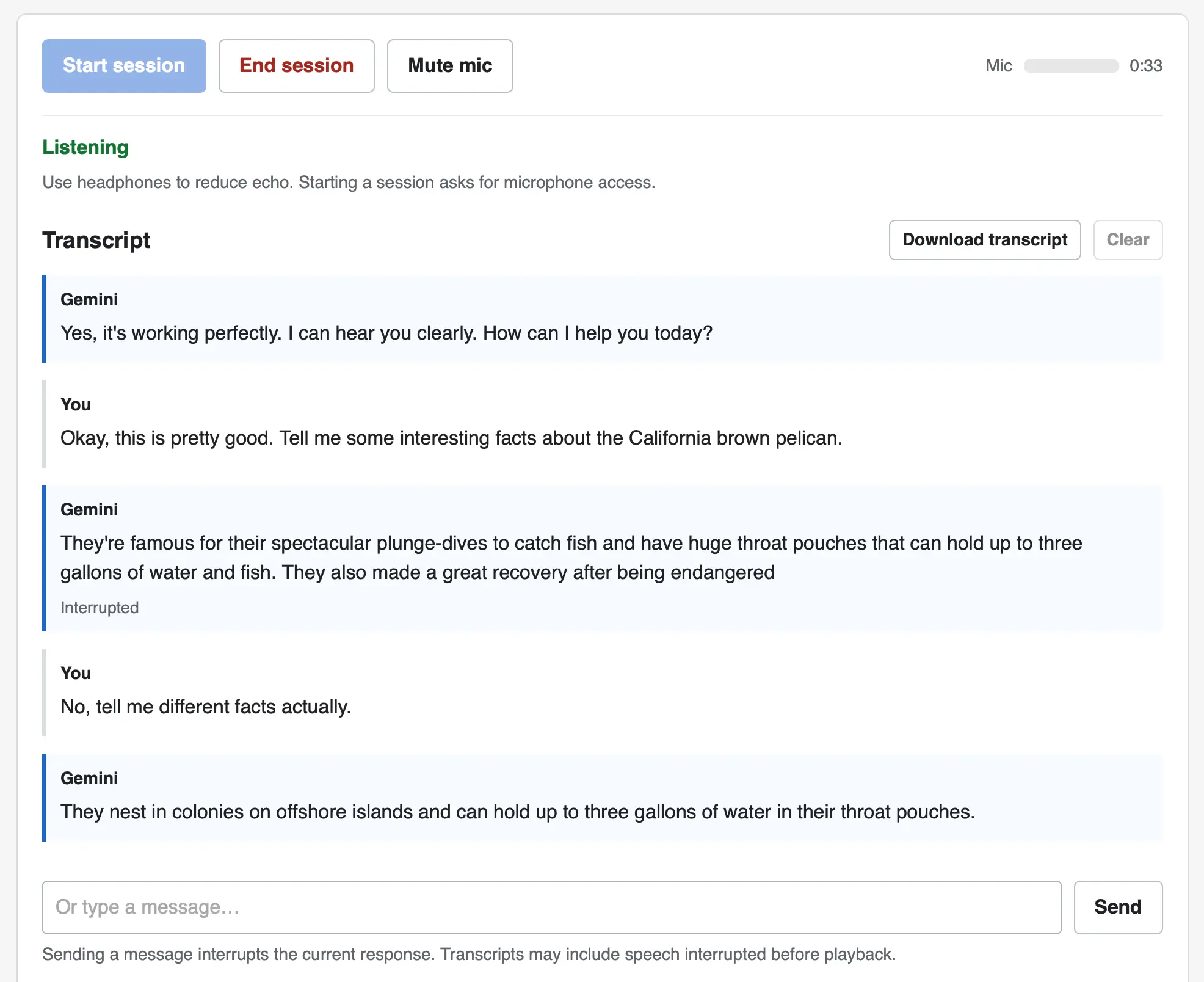
A developer built a browser demo letting you pick a model and voice preset, enter a system prompt, and interrupt the model mid-speech. Watch whether Google publishes its own tutorial on the WebSocket API.
WHO IT HITSDevelopers building voice interfaces can now choose between two Google speech-to-speech models, one tuned for extended thinking. Tool builders following the WebSocket API tutorial can test them in a browser without extra libraries.
Ask the AI about this article →
Summaries like this, in your inbox every morning.
Google's release of Gemini 3.8 Live and 3.8 Live Extended Thinking adds two speech-to-speech models to its lineup. The pair mirrors the shape of OpenAI's GPT-Live family, with one standard model and one extended-thinking variant, suggesting Google is positioning the two as alternatives for live voice applications rather than as distinct products.
Alongside the release, a browser-based demo UI was built against the documentation, letting users select a model and voice preset, enter an optional system prompt, and hold a voice conversation that can be interrupted while the model is talking. The implementation deliberately avoids libraries, connecting directly to a Google WebSocket endpoint and using a Web Audio API AudioContext for both capture and playback, which points to how lightweight a client for these models can be.
The practical test for these models is likely whether developers can get live voice conversations working without heavy dependencies, and whether Google's own tutorial makes that setup straightforward. For teams building voice interfaces, the extended-thinking variant may matter most where a live answer benefits from more deliberation, though that depends on how the models behave in practice.
For example, today's edition would include:
AI-summarized, only the topics you pick — one digest a day via Email, Slack, or Discord.
Free · 30 seconds with Google · unsubscribe anytimeWhat is AIToday? →
Ask AI anything about this article. Q&As are published on this page for other readers too.
Google launched Gemini 3.8 Live and Gemini 3.8 Live Extended Thinking, its most advanced voice models yet, wit…
Salesforce launched Koa, a reasoning model built on Nvidia's Nemotron open-weights platform, and Claudeforce…

Profound raised $180 million in a Series D led jointly by Sequoia Capital and Kleiner Perkins, at a $1.8 billi…
Hitachi says AI handles code conversion in legacy modernization, yet insists human engineers' role grows, coun…

Sam Altman told Fortune that OpenAI favors coordinating an industry-wide AI development slowdown with rivals i…

Perplexity released Portable Computer for Windows in partnership with Nvidia, via its existing Windows app