What happened
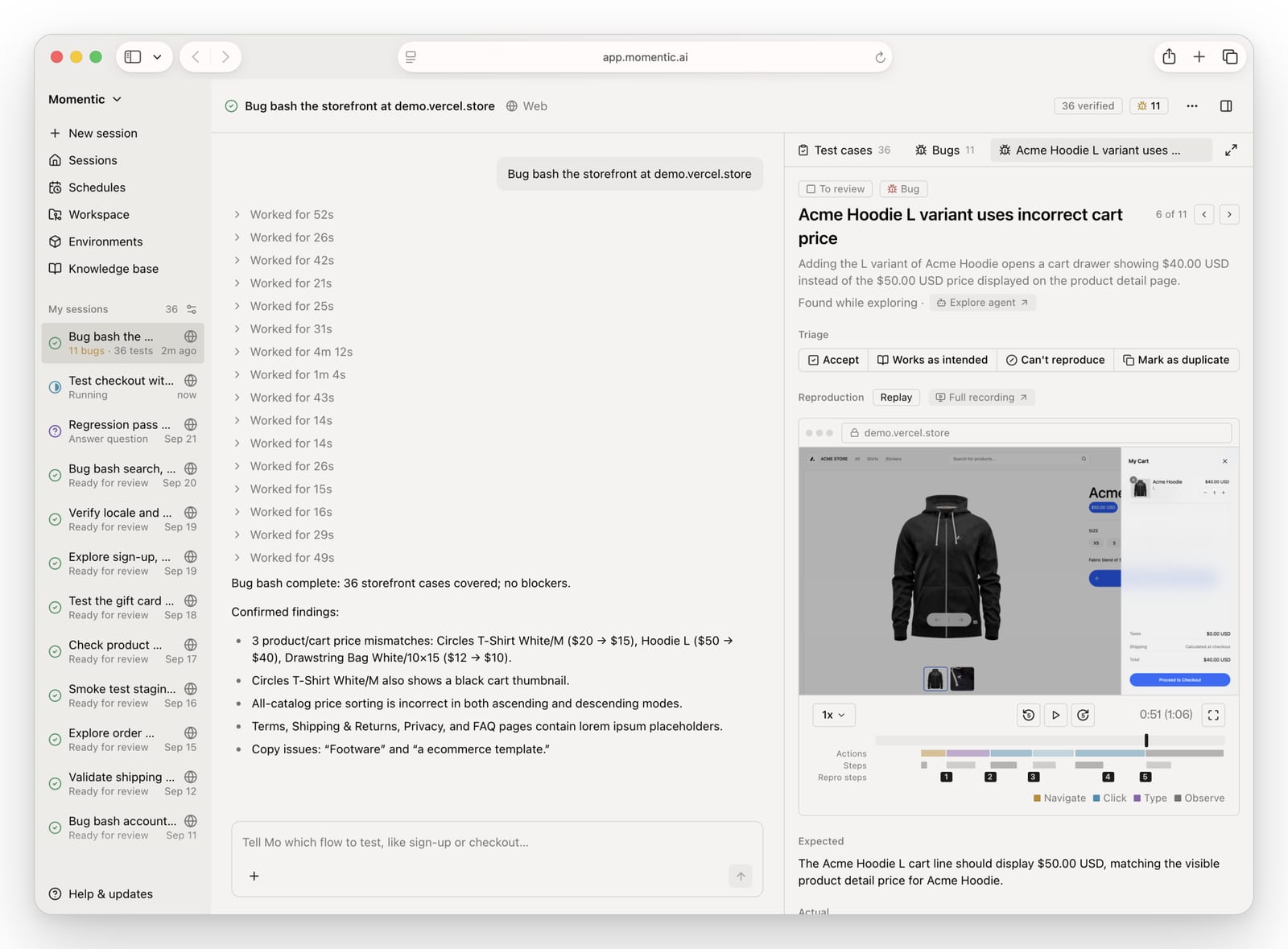
Momentic Inc. launched Mo, an AI agent that opens an app from a URL and prompt, spins up a swarm of agents to try thousands of permutations and edge cases, and reports failures with video evidence.
Why it matters
The launch removes the need for developers to write and maintain test scripts, which the company says become a liability every time an app changes, so QA teams can work from requirements and intent directly.
What to watch
Whether Mo can replace scripted suites in practice hinges on how well its agent swarm handles complex apps, where the article says more tests are needed and eventually become impossible to keep up. Watch customer results from Notion, Superpower, Iris, Committee for Children and Boundless, which have been putting Mo through its paces over the past few weeks.
WHO IT HITSQA engineers and developers who currently write, maintain and fix browser test scripts are the ones most directly affected, since Mo is pitched as removing that maintenance work. Teams using AI coding agents to generate code may also lean on it to keep testing in step.
Summaries like this, in your inbox every morning.
Momentic built its business on helping developers describe browser test workflows in ordinary language, which a large language model can reduce the labor for. But the company ran into a deeper version of the same problem: even an easier-to-maintain test artifact is still something somebody has to maintain. Mo is presented as the evolution that removes that intermediate layer, letting QA agents work from requirements and intent directly. As co-founder and CEO Wei-Wei Wu put it, "As long as you have scripts somewhere in your codebase, someone has to maintain it."
Mo takes the shape of the AI-coding tools developers already use day to day, with a web interface and chat box plus a command-line interface, and it can pull context from a product requirements document, Jira issue, Linear ticket or Confluence document. The wager is that agentic testing scales where scripted suites do not, since the more complex an application becomes, the more tests are needed and the heavier the maintenance burden grows.
The stakes hinge on whether that bet holds for complex apps and on whether teams trust agent-generated results enough to drop their own suites. Momentic said customers including Notion have been putting Mo through its paces over the past few weeks, so early evidence from those deployments is likely to shape how quickly the script-free approach spreads.
For example, today's edition would include:
AI-summarized, only the topics you pick: one digest a day via Email, LINE, or Slack.
Free · 30 seconds with Google · unsubscribe anytimeWhat is AIToday? →
Ask AI anything about this article. The AI reads this article, earlier AIToday articles, and Wikipedia, and cites its sources. Q&As are published on this page for other readers too.
Oracle group VP Johnnie Konstantas told theCUBE that agentic AI lets agents and sub-agents act as a proxy for…

Qiagen has manually curated biomedical data for more than 25 years with over 150 MD- and PhD-level experts, Bh…
Anthropic launched Claude Sonnet 5.5, a mid-tier model for everyday tasks, priced at $2 per million input toke…

NEAR, the token of the NEAR Protocol, has more than doubled in value over the past two weeks, helped by surgin…

Anthropic released Claude Sonnet 5.5, which it says runs output more than 30 percent faster and costs up to 30…

An analysis by Rowan Howard-Jones says AI agents likely from OpenAI ran over 16,500 scans of the UNCTADstat da…