What happened
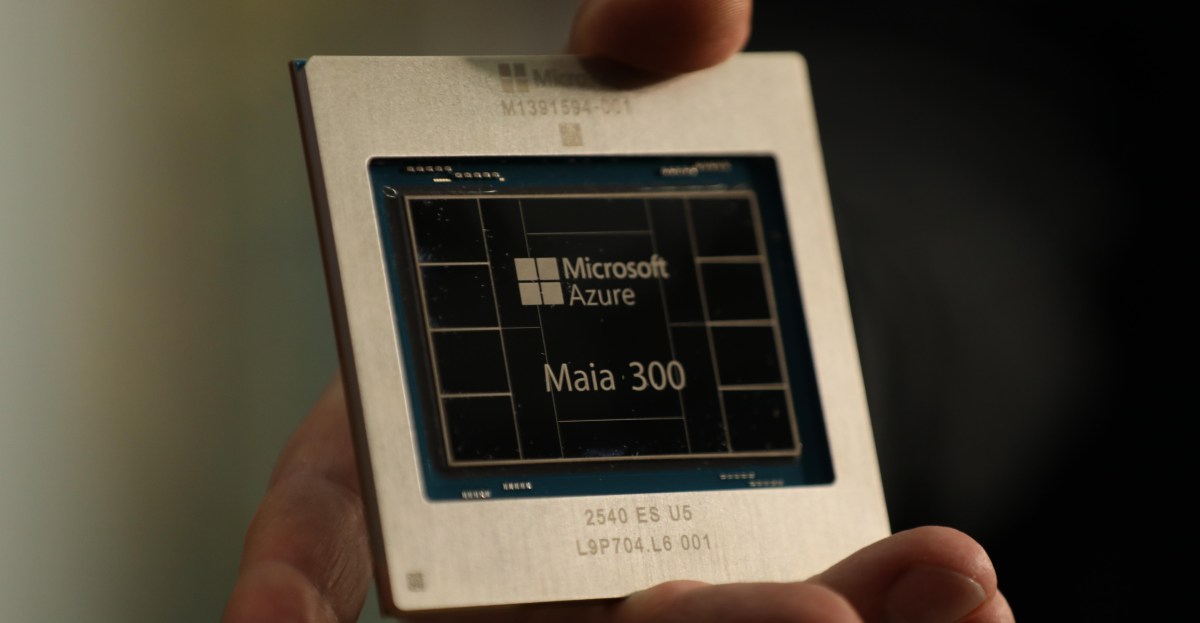
Microsoft announced Maia 300, its third-generation in-house AI chip, designed to be the "primary AI inference system" for Microsoft products and services, with 40 percent more tokens per megawatt than leading GPU-based systems and up to 7x the rack-scale token throughput of Maia 200 in a full 96-accelerator configuration.
Why it matters
The efficiency gains are meant to let Microsoft run AI inference on its own silicon instead of buying competing chips, and the company says it plans multi-gigawatt deployments from 2027, with its cloud group chief calling Maia 200 its best-performing AI infrastructure.
What to watch
Production rollout of Maia 300 starts in 2027.
WHO IT HITSCloud infrastructure and procurement teams at large enterprises that buy AI inference capacity could see a shift in pricing and availability of GPU-based options as Microsoft moves more of its workloads onto its own silicon; the body does not quantify any price change.
Summaries like this, in your inbox every morning.
Maia 300 is the successor to Maia 200, which Microsoft announced only in January and which is already running production AI workloads across the company, including Microsoft Copilot, GitHub Copilot, Microsoft Foundry, and Microsoft's own AI models. The company's cloud group chief described Maia 200 as the best performing AI infrastructure in its fleet, measured in real world metrics for AI services.
Microsoft says the new chip is designed for long-context reasoning, latency-sensitive conversational experiences, and sustained, multi-step agentic tasks. It uses a chiplet architecture built on TSMC's N2P process node that separates compute, memory controller, and I/O functions, which Microsoft says increases the silicon area dedicated to compute performance and lets each function use the technology best suited to its role.
The chip is also tied to Microsoft's own model ambitions. Its AI chief said the company needs a platform it owns and co-designs with its models, making the work of running Microsoft AI models on Maia a critical focus.
Pick your industry and the AI tools you use, and get news related to your work every day.
Free · 30 seconds with Google · unsubscribe anytimeWhat is AIToday? →
Ask AI anything about this article. The AI reads this article, earlier AIToday articles, and Wikipedia, and cites its sources. Q&As are published on this page for other readers too.
Microsoft will deploy its Azure Maia AI chips at multi-gigawatt scale starting in 2027, making them the compan…
Blueprints AI is unveiling a second-generation version of its software that generates code-compliant, permit-r…

The Ray LLM Deep Learning Container deploys one large language model across two GPU nodes on Amazon EKS, with…

Mistlabs Ltd. took Ambi out of beta on Apple devices, backed by $26 million in Pre-A funding led by Luminous V…

Loops Smart AI raised $3.5 million in seed funding led by Andreessen Horowitz's a16z speedrun accelerator, wit…
Chinese AI glasses launched through August 2026 averaged 38.1 grams, 30% lighter than the 54.4-gram average fo…