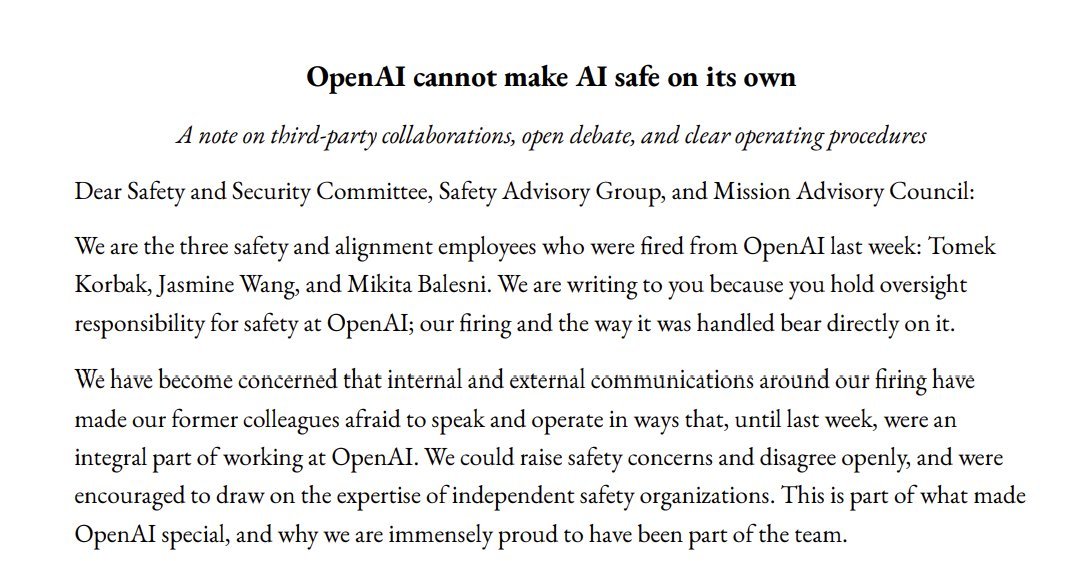
What happened
Mikita Balesni, Jasmine Wang, and Tomek Korbak said on October 8 they were fired the previous week and that no written reason was given; OpenAI said the same day that an internal investigation found they violated explicit confidentiality rules.
Why it matters
The two sides tell opposite stories about the same dismissals — the researchers say they are being punished, while OpenAI says it found serious trust violations beyond what the letter describes and stands by the decision, without saying which rule was broken or how.
WHO IT HITSThe dispute lands on OpenAI's remaining safety and alignment staff, who may read the firings and the secrecy around them as a warning about how far they can discuss their work with outside researchers.
Summaries like this, in your inbox every morning.
The letter was addressed to OpenAI's Safety and Security Committee, its Safety Advisory Group (SAG), and its Mission Advisory Council, and it warns that the way the dismissals were handled — and explained, inside and outside the company — is having a chilling effect on the employees who remain. All three researchers worked on monitorability, keeping an AI's chain of thought visible to human oversight. Korbak and Balesni had also taken part in the investigation of a July breach at Hugging Face, and Korbak served as the technical contact with METR, the U.S. organization that ran the external review.
In his own account, Balesni said his exit interview told him he had talked too much with outside safety research organizations and was therefore no longer trustworthy, and that he was left with the implication he had leaked intellectual property — which he denies, saying his work was coordinated with his manager, research executives, and the board. Wang said the only reason she was given was accessing an executive's email, an access she says the company granted her for recruiting, that she asked IT to remove unused, and that she reported within minutes when she opened a sensitive message by mistake. She has asked for any other reasons in writing.
The letter also says the three were not the sources for a U.S. The Information article about a new architecture that is hard to monitor, and it says suspicions that they shared board-level documents were never put to them and they had no chance to respond. On September 12, CEO Sam Altman had said on X that he agreed with Anthropic CEO Dario Amodei on giving independent evaluators the same access as employees; Balesni said he worries the firings will be used as a pretext to cut the METR relationship, and Wang urged the attorneys general of California and Delaware to make OpenAI keep that promise. OpenAI's statement says the decision was not about safety concerns, that it has never fired anyone for raising them, and it thanks the three for their past contributions.
Pick your industry and the AI tools you use, and get news related to your work every day.
Free · 30 seconds with Google · unsubscribe anytimeWhat is AIToday? →
Ask AI anything about this article. The AI reads this article, earlier AIToday articles, and Wikipedia, and cites its sources. Q&As are published on this page for other readers too.
IBM's Bruno Aziza said the number of AI agents employees build will outpace what companies can manage, so firm…
AMD said on Sept. 28 it agreed to buy World Labs, which makes AI models of 3D spaces and robot-training tools…
Nathan Lambert published an essay arguing AI progress will accelerate through engineering and infrastructure g…
Writing on Zenn, Taichi Endoh — a clinical engineer and AI engineer — says the first step in a leak is to defi…

Wedbush analysts Dan Ives and Antoine Legault wrote that the DeepSeek moment is a positive catalyst for US AI…
The AI recipe newsletter's editorial team asked Claude three trick questions — the iron-and-feathers weight pu…

