What happened
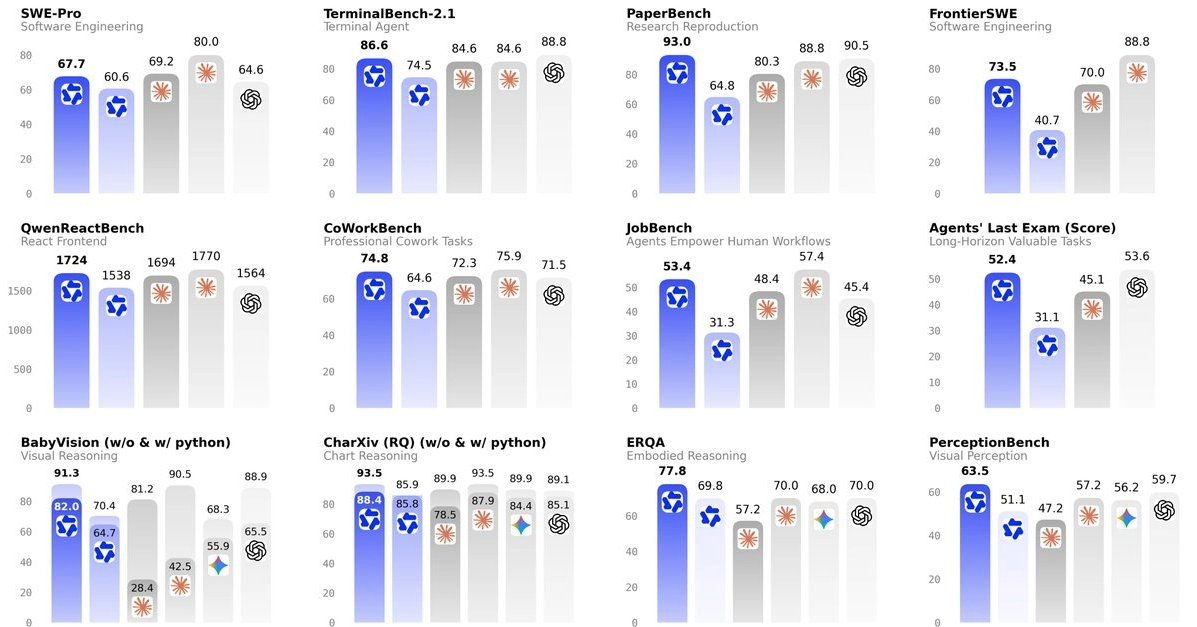
Alibaba Cloud unveiled Qwen3.8-Max on August 3rd, a 2.4 trillion parameter AI model that the company will open-source next week. On the coding benchmark Terminal Bench 2.1, it outscored Claude Fable 5; on SWE-bench Pro, it exceeded GPT-5.6 Sol's results.
Why it matters
This is Alibaba Cloud's first release of a model at this scale with open weights (public model parameters), widening access to a high-performance alternative to proprietary US AI systems. In a demo, the model sustained autonomous coding work for over 10 days and handled research, legal, and design tasks — signaling potential for enterprise automation.
What to watch
The model weights and a smaller variant, Qwen3.8-27B, launch next week. API pricing is $2 per million input tokens and $6 per million output tokens on Qwen Studio and QwenCloud. On some coding benchmarks (DeepSWE 1.1), it still trails Claude Fable 5 and GPT-5.6 Sol.
Summaries like this, in your inbox every morning.
Alibaba Cloud's release of Qwen3.8-Max represents a strategic push to compete with US-based AI labs by offering an open-source alternative at scale. The 2.4 trillion parameter model, which the company notes is the first of its size to be open-sourced by Alibaba Cloud, challenges the dominance of closed proprietary systems like OpenAI's GPT-5.6 Sol and Anthropic's Claude Fable 5. The benchmark results are mixed: the model leads on some coding tasks (Terminal Bench 2.1 and SWE-bench Pro) but lags on agent-focused benchmarks (DeepSWE 1.1), suggesting strong performance in narrow domains but potential gaps in more complex autonomous reasoning.
The timing of the open-source release—scheduled for next week—indicates a commitment to rapid democratization, a strategy that could lower barriers for developers and organizations outside the US and accelerate adoption in regions where proprietary model access is constrained. The demo showcasing 10+ days of autonomous coding work hints at practical long-horizon reasoning capability, though this claim rests on a single demonstration rather than systematic benchmark validation. The API pricing ($2 input / $6 output per million tokens) and availability on Alibaba Cloud's own platforms (Qwen Studio, QwenCloud) suggest the company is positioning this as an integrated ecosystem play rather than a standalone open-source release.
Pick your industry and the AI tools you use, and get news related to your work every day.
Free · 30 seconds with Google · unsubscribe anytimeWhat is AIToday? →
Ask AI anything about this article. The AI reads this article, earlier AIToday articles, and Wikipedia, and cites its sources. Q&As are published on this page for other readers too.
Cerebras chief strategy officer Andy Hock said that over the past two months, foundation labs and enterprises…
nFOX Lab launched the nFOX Platform for managing owned large language models and announced plans to open-sourc…

Oppenheimer said investors look forward to understanding the return on Meta's AI assistant Muse, which UBS ana…
Bank of America CEO Brian Moynihan said 1,000 outside contractors joined 3,000 internal employees fixing vulne…
On TheoPhysEval, GPT-6-Astra got 49 of 50 unpublished theoretical physics problems right — 98% — at under $3 e…

Microsoft and Nvidia held a launch party in San Francisco for the first RTX Spark laptops, which use Arm chips…