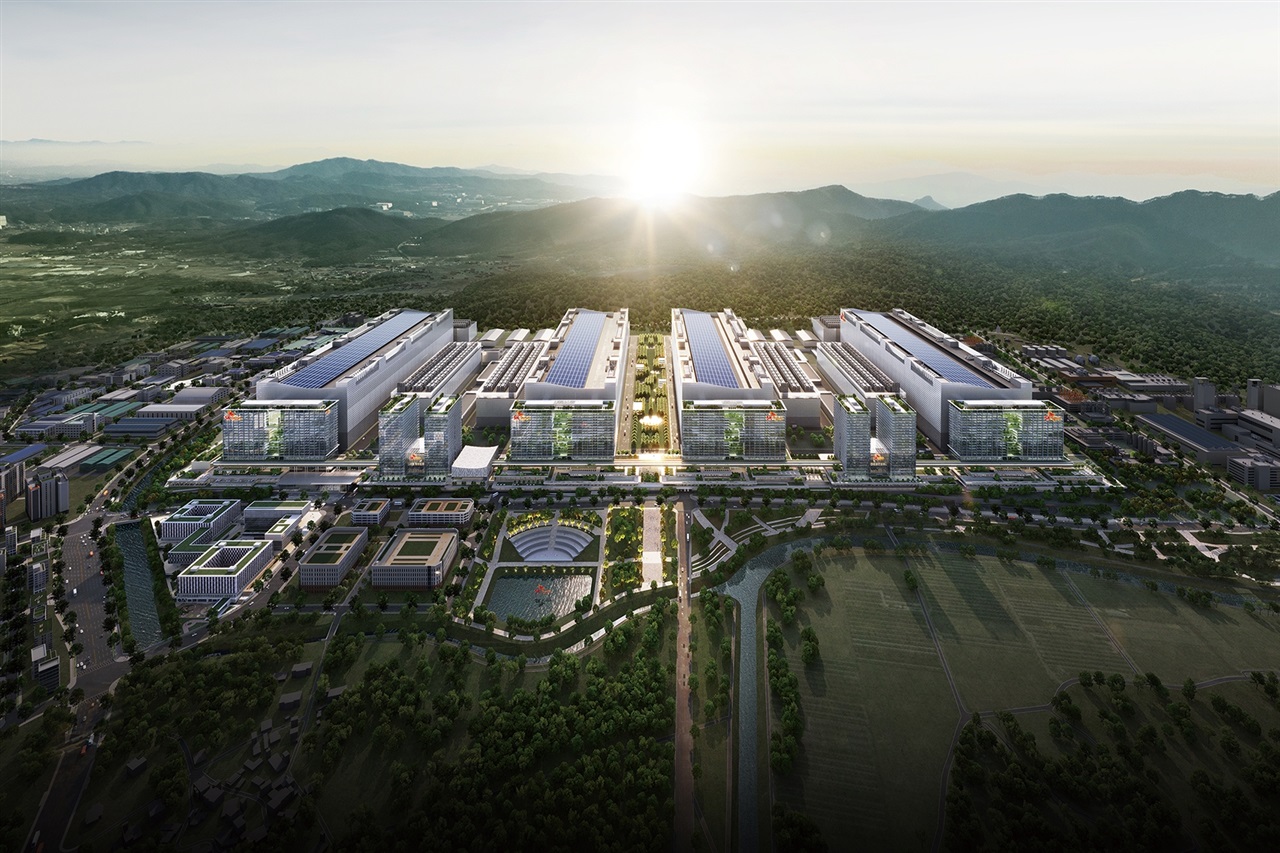
SK Hynix has committed roughly US$39 billion to build two new semiconductor fabs in South Korea—one producing advanced DRAM and the other NAND flash memory—as artificial intelligence adoption drives demand for high-capacity chips.
The company describes the investment as a proactive bid to secure manufacturing capacity rather than chase a cyclical market opportunity, reflecting confidence in sustained long-term AI-driven memory demand.
What happened
SK Hynix approved roughly KRW54 trillion (approx. US$39 billion) in new fab construction at two domestic sites—KRW35.2 trillion for a second Yongin fab and KRW19.1 trillion for a new Cheongju NAND plant.
Why it matters
The investment signals SK Hynix's strategy to secure production capacity as AI systems drive demand for memory chips, rather than simply responding to near-term market cycles. Memory manufacturers are competing to expand output before supply constraints tighten.
What to watch
The company frames this as a supply-security move, meaning completion timelines and ramp-up volumes for both fabs will be critical to whether SK Hynix can meet anticipated AI workload demands.
SK Hynix announced the approval of roughly KRW54 trillion (approx. US$39 billion) in new fab construction, split between two facilities in South Korea. The larger allocation—KRW35.2 trillion—goes toward a second fabrication plant in Yongin, which will produce advanced DRAM memory. The remaining KRW19.1 trillion will fund a new NAND flash plant in Cheongju. The company characterized the investment as a strategic move to secure production capacity in response to rising AI memory demand, explicitly distancing it from cyclical market-chasing behavior. By investing in both DRAM and NAND facilities, SK Hynix is positioning itself to supply the full spectrum of memory chips needed by AI systems and data centers. The commitment underscores confidence among major memory manufacturers that artificial intelligence adoption will drive sustained demand for high-capacity chips over the coming years.
SK Hynix's $39 billion commitment represents a significant capital deployment aimed at future-proofing its memory production. The investment is split between DRAM (at Yongin) and NAND flash memory (at Cheongju), two critical components of AI infrastructure—DRAM for runtime processing and NAND for data storage. By explicitly framing this as a supply-security play rather than a cyclical response, SK Hynix is signaling confidence that AI-driven memory demand will sustain well into the future, justifying the large upfront capital outlay. The domestic South Korea focus keeps production geographically concentrated, allowing the company to maintain control over manufacturing standards and supply chains during a period of rising geopolitical semiconductor competition.
AI-summarized, only the topics you pick — one digest a day via Email, Slack, or Discord.
Free · takes 30 seconds · unsubscribe anytime
Ask AI anything about this article. Q&As are published on this page for other readers too.
QumulusAI announced a GPU-as-a-Service agreement with DRW, a global trading firm, to supply a dedicated NVIDIA…

OpenAI introduced Premium Seats for ChatGPT Business, priced at $125 per user per month ($100 with annual bill…

Anthropic pledged to embed machine-readable watermarks in Claude-generated text and digitally signed provenanc…

OpenAI announced that its unreleased model Astra had produced solutions to 10 long-standing mathematics proble…

Anthropic confirmed it will add watermarks to text generated by Claude and other models to comply with the EU…

Tech companies are raising unprecedented sums for AI infrastructure—$194 billion so far in 2026 by just four f…

The AI news that matters, in one minute each morning.
Sign up free