Researchers discovered "meta-tokens" in the Qwen3.6-27B language model—specific tokens that activate when the model performs hidden computations, such as solving math problems or resolving ambiguous text. By manipulating these tokens, they were able to change the model's output, demonstrating a new way to peek inside and steer the algorithms that run inside modern AI systems.
Summaries like this, in your inbox every morning.
Sign up free →What happened
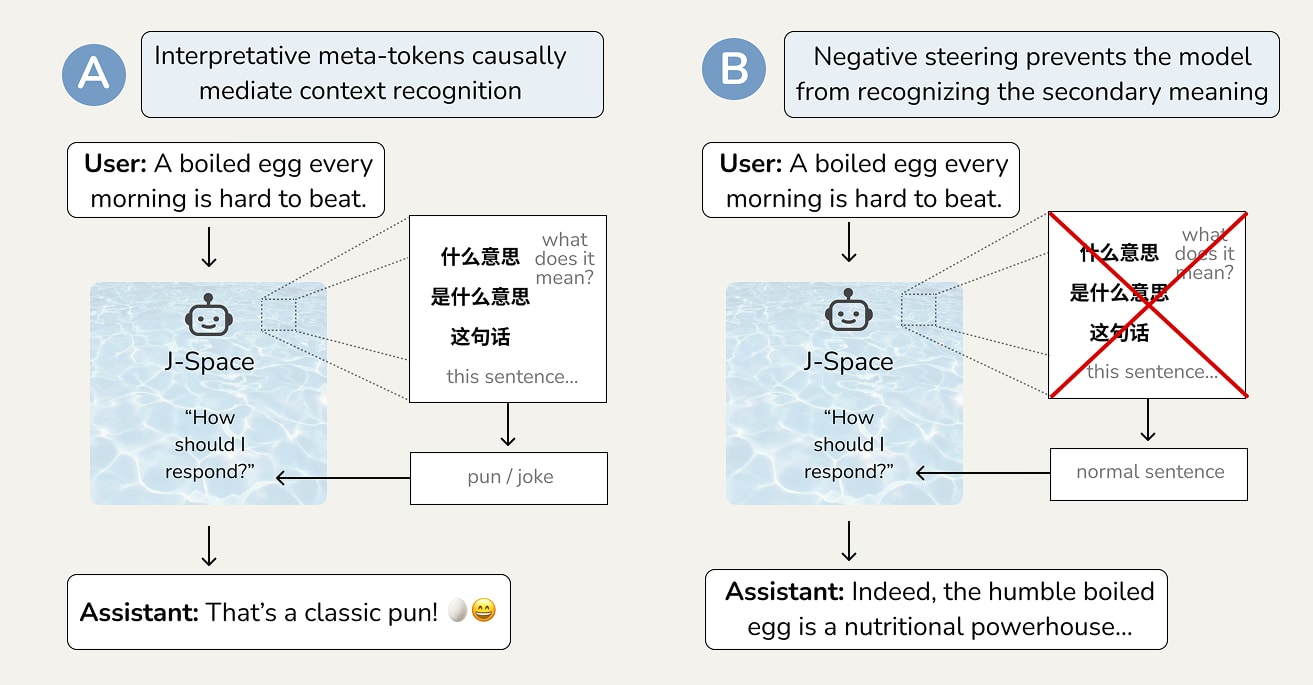
Researchers used J-lens on Qwen3.6-27B to identify 'meta-tokens'—tokens that reveal non-obvious computation inside the model. They found that 什么意思 ("what does this mean") fires when the model encounters ambiguous text, 大概率 ("most likely") activates before the model hedges, and "gcd" appears during logical computation problems, each triggering specific algorithmic behavior.
Why it matters
By steering these meta-tokens, researchers showed they can change the model's output: suppressing the hedging token makes the model commit to a single answer instead of listing options; steering the GCD vector changes the answer to an LCM problem from 270 to 810. This technique offers a concrete way to understand and influence what algorithms the model actually runs, rather than treating it as a black box.
What to watch
The current J-lens method is limited by a single-token constraint, making meta-tokens hard to locate. Future multi-token J-lens methods could surface more of the model's internal algorithms, potentially yielding deeper insights into how large language models solve reasoning problems.
Researchers applied J-lens, a technique for finding meaningful activations in a model's internal state, to Qwen3.6-27B, a 27-billion-parameter language model. Their goal was to identify "meta-tokens"—tokens that surface computation the model performs that is not obvious from the text alone.
They found three striking examples. First, when the model reads ambiguous text, the token 什么意思 ("what does this mean") fires in the model's J-space representation. By steering this token away, they altered the model's interpretation of ambiguous inputs: "a boiled egg every morning is hard to beat" normally triggers a pun-catching response, but suppressing 什么意思 makes the model answer with nutrition facts instead. Second, on logical computation problems, the token "gcd" activates, pointing at the product/GCD algorithm the model is running. When they swapped the GCD vector from a value of 9 to 3, the model changed its answer for the LCM (least common multiple) of 27 and 90 from 270 to 810. Third, before the model hedges or lists multiple options, the token 大概率 ("most likely") fires; suppressing it forces the model to commit to a single answer—for example, turning the ambiguous statement "There are several logical places John could have gone" into a definite claim: "he went to the stationery store."
The researchers acknowledge that meta-tokens are challenging to discover with J-lens's current single-token constraint. However, they note that future methods capable of detecting and manipulating multi-token patterns could unlock much richer insights into the model's internal algorithms. This suggests a pathway from narrow probing of individual algorithmic steps toward a more complete map of how large language models execute reasoning.
Understanding how language models actually compute is a long-standing goal in AI research. Rather than treating the model as a black box that simply maps inputs to outputs, this work attempts to expose the internal mechanisms—the specific tokens that correspond to the model running particular algorithms. The use of J-lens, a tool for locating meaningful activations in a model's internal representation space, allowed the researchers to move beyond generic feature attribution and find tokens that correlate with concrete algorithmic behavior.
The practical value lies in steering: once you know which token corresponds to, say, a gcd calculation or a hedging behavior, you can manipulate that token's activation and change the output in predictable ways. This opens a path from interpretability (understanding what the model does) to controllability (directing what it does). However, the current method's single-token constraint limits how deeply researchers can explore—many algorithms may require multiple tokens working together. The body suggests that scaling J-lens to handle multi-token patterns is the natural next frontier.
AI-summarized, only the topics you pick — one digest a day via Email, Slack, or Discord.
Free · takes 30 seconds · unsubscribe anytime
No discussion yet for this article
Get curated AI news from 200+ sources delivered daily to your inbox. Free to use.
Get Started FreeFree · takes 30 seconds · unsubscribe anytime
1 minute a day. The AI essentials.
200+ sources · Email / LINE / Slack