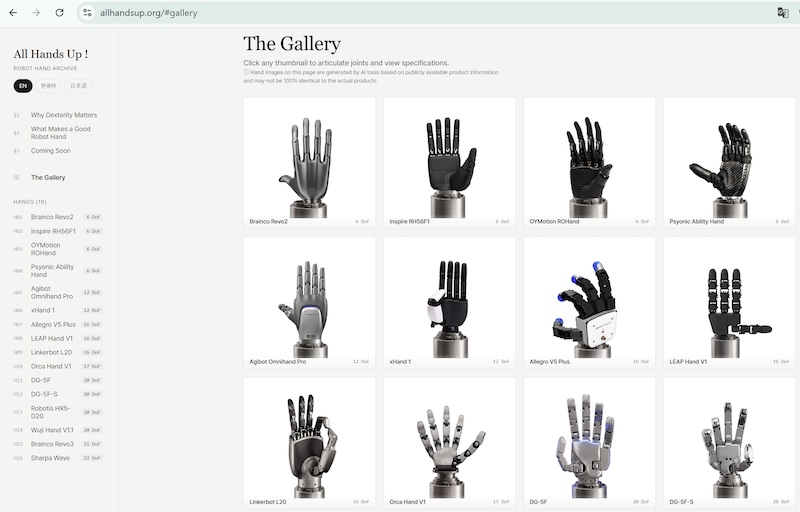
RLWRLD has launched All Hands Up!, an open web platform that provides real-world operational data and interactive visualization tools for dexterous robotic hands, addressing the lack of comparative performance information across commercially available options.
The platform currently covers more than 10 robotic hands and uses RLWRLD's proprietary DexBench benchmark to analyze performance across 18 real-world manipulation tasks, helping manufacturers, researchers, and industry partners evaluate robotic hand trade-offs and make clearer adoption decisions.
What happened
RLWRLD, a physical AI company, unveiled All Hands Up!, a free web platform that shares real-world performance data and design trade-offs of dexterous robotic hands. The platform includes data on more than 10 robotic hands and offers interactive visualization tools and side-by-side comparisons accessible directly in a web browser.
Why it matters
Robotic hands are a core component of physical AI, but no single product today can satisfy all requirements due to inherent trade-offs between size, grip force, and back-drivability (the ability to respond compliantly to external forces). The platform addresses a question repeatedly raised in research and industry: which robotic hands perform effectively in real-world environments. This shared reference point may help manufacturers validate designs and help researchers and partners set clearer adoption criteria.
What to watch
RLWRLD proposes a dual-hardware strategy—Type 1 for field deployment (lightweight, durable) and Type 2 for training data collection (high back-drivability, precision)—reflecting that no perfect robotic hand yet exists. The company plans regular quarterly content updates to the platform.
Ask the AI about this article →
Robotic hands are widely recognized as foundational to physical AI, yet the market lacks standardized, transparent performance data across options. Each existing robotic hand carries structural trade-offs: reducing size weakens grip force because smaller internal actuators and motors produce less power; conversely, increasing the gear ratio to strengthen grip compromises back-drivability—the ability to respond compliantly to external forces and impacts. This means no single hand satisfies all requirements simultaneously, and manufacturer specification sheets alone do not capture real-world operating performance.
RLWRLD's All Hands Up! platform addresses this gap by sharing operational data collected from the company's firsthand experience with commercially available hands. By providing interactive visualization based on URDF (the standard robot description format), side-by-side comparisons, and benchmark results from 18 real-world manipulation tasks, the platform offers manufacturers, researchers, and industrial partners a common reference point to validate designs and set adoption criteria. The company's proposed dual-hardware strategy—Type 1 for field deployment and Type 2 for training data collection—reflects the current reality that complementary use of different hands may be a practical path forward until a more universal solution emerges. Planned quarterly updates suggest RLWRLD intends this as an evolving industry resource rather than a static snapshot.
For example, today's edition would include:
AI-summarized, only the topics you pick — one digest a day via Email, Slack, or Discord.
Free · takes 30 seconds · unsubscribe anytimeWhat is AIToday? →
Ask AI anything about this article. Q&As are published on this page for other readers too.
Visko raised $10 million in pre-seed funding from Llama Ventures and opened public access to its first foundat…

K-Safety Expo 2026 will be held at BEXCO in Busan from September 2–4, featuring AI, robots, sensors, and conne…

U.S. markets ended August higher, with the S&P 500 up 2.6% and the Nasdaq up 3.9%

Neurovia AI, an Abu Dhabi-based company, is pitching Saudi security agencies software that it says can compres…

AI company Runway has unveiled Solaris, the first model in a new category it calls "Interface World Models." I…

John Deere introduced JD, a conversational AI tool that lets farmers ask open-ended questions about their hist…