What happened
SharonAI Holdings expanded its secured AI factory capacity to 212 megawatts (up 80 MW from prior guidance of 132 MW), with 120 MW contracted under multiyear take-or-pay agreements and 92 MW available to sell. The company's contracted revenue book reached approximately $8.8 billion year to date, up from $2.2 billion three months earlier. Key deals include a $4.9 billion six-year strategic compute collaboration with NVIDIA involving 40,000 GB300 GPUs, plus agreements with a global AI lab ($1.32 billion), a global technology company ($950 million), and a global AI platform ($373 million).
Why it matters
SharonAI is building a major GPU infrastructure business across Australia and New Zealand to serve AI model builders and inference providers. The fourfold increase in contracted revenue and more-than-doubled capacity in three months suggests strong demand for GPU services as customers need more computing power for AI workloads. The company expects to deploy more than 64,000 NVIDIA GPUs by mid-2027, with first material revenue beginning in the fourth quarter of 2026 as large-scale deployments come online.
What to watch
SharonAI expects the vast majority of the 40,000 GPUs in the NVIDIA program to be deployed during the first half of 2027 under three- to five-year take-or-pay contracts. The company's revenue ramp will depend on hardware delivery from suppliers and data-center readiness, which management is actively tracking. SharonAI's contracting visibility extends through 2031, and the company has raised approximately $2.2 billion since December 2025.
Summaries like this, in your inbox every morning.
SharonAI's earnings call reveals a company scaling rapidly at a critical juncture for AI infrastructure deployment. The expansion from 100 MW of capacity and $2.2 billion in contracts just three months prior to 212 MW and $8.8 billion represents acceleration driven by large-scale enterprise demand for GPU compute. The NVIDIA partnership is especially significant: a $4.9 billion minimum revenue commitment with an anchor pricing model positions SharonAI to capture upside as GPU demand allows higher pricing—a dynamic the company is already experiencing, as evidenced by the $4 per GPU hour rate for its most recent AI platform agreement. CEO James Manning emphasized that demand for GPU capacity remains constrained, suggesting pricing power and customer desperation for compute resources.
The company's capital strategy reflects confidence in this market: SharonAI has raised $2.2 billion since December 2025 and is pursuing additional debt facilities, but it is not building greenfield data centers itself. Instead, it partners with operators like NEXTDC while securing GPU supply from NVIDIA and storage from VAST Data. This capital-light model allows SharonAI to scale without the balance-sheet drag of infrastructure construction. The deployment timeline is clear: initial megawatts from a new Australia partner could arrive as early as late 2026, with the majority of capacity online through 2027. Contracting visibility extends to 2031, indicating long-term customer lock-in through multiyear take-or-pay agreements that reduce execution risk.
For example, today's edition would include:
AI-summarized, only the topics you pick: one digest a day via Email, LINE, or Slack.
Free · 30 seconds with Google · unsubscribe anytimeWhat is AIToday? →
Ask AI anything about this article. The AI reads this article, earlier AIToday articles, and Wikipedia, and cites its sources. Q&As are published on this page for other readers too.
Anthropic launched Claude Sonnet 5.5, a mid-tier model for everyday tasks, priced at $2 per million input toke…

NEAR, the token of the NEAR Protocol, has more than doubled in value over the past two weeks, helped by surgin…
Michael Burry wrote in a Substack chat that Trump's team knows the AI buildout is 'the only thing keeping this…

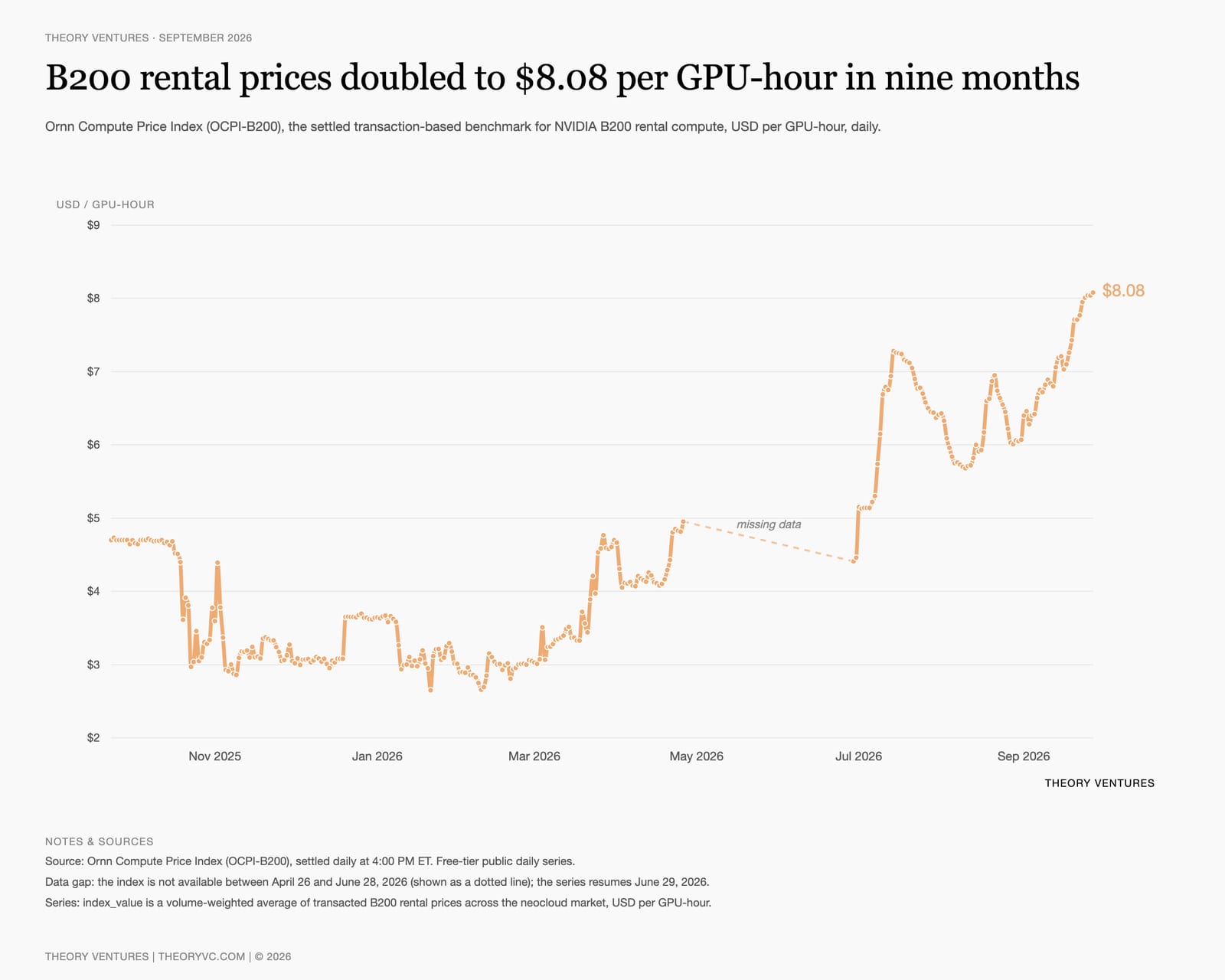
GPU rental prices doubled in six months, from $4.40 to $8.08 per GPU-hour, even as Claude Opus 5.5 costs 40% l…
Anthropic released Claude Sonnet 5.5, which it says runs output more than 30 percent faster and costs up to 30…

The University of Florida found only 10-15% of its data was semantically defined; using NaviGator AI and Snowf…