What happened
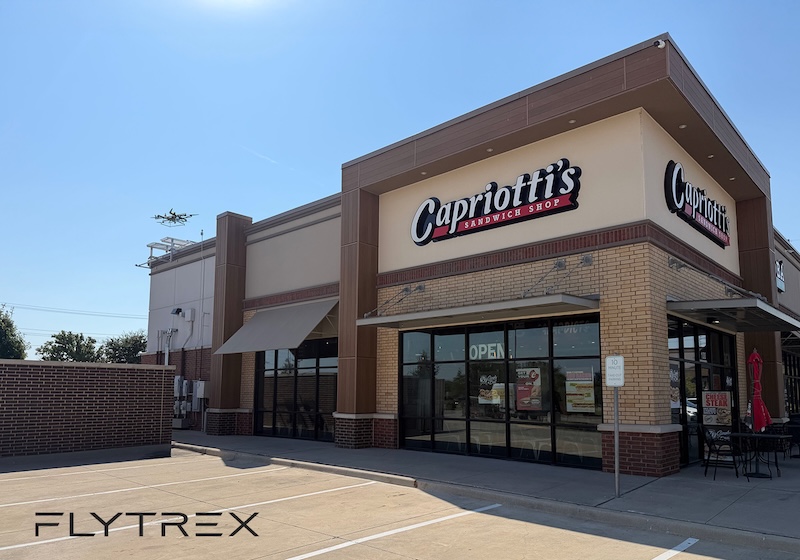
Flytrex launched rooftop docking and predictive AI positioning at active merchant locations across the Dallas-Fort Worth metro, with over 100 additional sites underway. Amit Regev, co-founder and CEO, said the system knows where the next order is coming from before it's placed.
Why it matters
The company says restaurant self-loading removes dedicated runners and predictive positioning eliminates the pickup flight time. That is what makes the model lightweight and repeatable across restaurants and shopping centers, per Flytrex.
What to watch
The claimed figures are Flytrex's own, so the test is whether the model holds up as installations scale beyond the initial sites. Watch the rollout of the over 100 additional sites across the Dallas-Fort Worth metro.
WHO IT HITSRestaurant operators hosting rooftop docks take on order-loading themselves, replacing dedicated runners, while Flytrex's drone fleet gains higher utilization from the same aircraft. Delivery customers stand to get faster drop-offs if the 60 percent cost and half-time figures hold.
Summaries like this, in your inbox every morning.
Flytrex's pitch rests on a diagnosis its CEO, Amit Regev, puts bluntly: the hard part of drone delivery was never the flight, but "the last few hundred feet between the kitchen and the aircraft." Traditionally, drone delivery companies have dispatched from a centralized location once an order is ready, which adds time and cost. Flytrex's answer is to move the waiting point to the restaurant roof and to predict demand before it appears, using machine-learning models that analyze historical demand patterns, time of day, location and other signals.
The physical side of that is a dock that needs no extra real estate, no structural modifications and no dedicated drone staff — restaurant employees simply clip the order onto a hook. The software side prepositions idle aircraft at merchants most likely to order next. Together, Flytrex says, these remove two of the largest costs and delays in the business: the runners who carried orders to a separate pickup point, and the pickup flight itself.
The announcement lands amid a run of milestones for Flytrex: investment from Uber tied to a partnership to fulfill Uber Eats orders, a DoorDash partnership for drone delivery in Dallas, FAA approval for Beyond Visual Line of Sight operations, the Sky2 drone unveiled with Little Caesars, a manufacturing facility in Pilot Point, Texas, and a partnership with Nash across its DFW operations. Whether the 60 percent cost cut and halved delivery times translate from initial sites to a larger footprint is likely to hinge on how well the predictive models hold up as the network grows.
Pick your industry and the AI tools you use, and get news related to your work every day.
Free · 30 seconds with Google · unsubscribe anytimeWhat is AIToday? →
Ask AI anything about this article. The AI reads this article, earlier AIToday articles, and Wikipedia, and cites its sources. Q&As are published on this page for other readers too.
On Micron's fiscal Q4 2026 earnings call, CEO Sanjay Mehrotra said humanoid robots are expected to need memory…
RobotPlusPlus closed a Series C worth "hundreds of millions of RMB (tens of millions of USD)" led by Qianggang…
Runway announced Praxis-1, its first open-weight world action model for controlling robots, built on the same…
Boston Dynamics released Spot 5.2, expanding Orbit fleet software with a Model Context Protocol layer that let…
Utopia Compression, a Los Angeles company with over two decades of defense work, is marketing AI-based passive…
Writing for Robotics and Automation News, Unbox Robotics CEO Pramod Ghadge said reverse logistics needs AI dec…